de
close
The Threshold of Impermanence

Caline Aoun

Introduction

The solo exhibition The Threshold of Impermanence by Caline Aoun spans the Kunstmuseum and the Kunsthalle Appenzell and explores the conditions under which natural and artificial systems emerge, operate, and transform. Aoun’s internationally established practice renders invisible processes perceptible and engages with key questions of our present – ecological fragility, technological pervasiveness, and the ways in which we engage with time and resources. The exhibition does not present finished works, but rather process-based states that shift over time and in response to space, climate, and interaction.

Impermanence is not framed as loss, but as a condition of transfor-mation. The exhibition does not present autonomous objects, but configurations in which materials accumulate, shift, dissolve, or tran-sition into other states. The spaces become experimental arrangements in which materials interact and actively shape their environment.

Across both venues, a trajectory unfolds from the elemental to the cultural, from physical processes to image and information systems. At the Kunstmuseum, the focus is on water, condensation, light and heat; at the Kunsthalle, the emphasis shifts to printing ink, circulation, image production and data. Together, the works trace a present in which nature, technology and perception are inextricably intertwined. What remains is not the stable artwork, but the trace: of time, of energy,
of circulation.

We recommend beginning your visit at the Kunstmuseum.
Kunstmuseum Appenzell Part One: The Elementary

At the Kunstmuseum, the focus is on the elemental: water, air, light, heat and gravity as forces that precede images and meaning. The works do not present representations of nature, but allow physical processes to appear directly. Condensation, evaporation, reflection, heat conduction and material transformation take place within the space. In this way, Caline Aoun pursues artistic practices that approach nature not as image but as process, while situating this approach within a contemporary context in which natural and technological conditions are inextricably intertwined.

The exhibition unfolds as a sequence of threshold states. Water is collected, channelled, released or leaves traces; humidity condenses on metal surfaces; light becomes heat; organic material becomes a repository of time. The rooms do not follow a linear narrative, but a progression of states and intensities. What becomes visible is how materials register, transmit and store forces. Aoun treats material as something that responds to external influences and continually transforms. At the same time, her work extends this perspective through a precise attention to energy flows, climatic conditions and temporal processes.

The Kunstmuseum thus does appear as an active resonant space, in which climate, time of day, architectural conditions and use become integral components of the works. The rooms respond to temperature, humidity and light; surfaces retain traces of previous states and release them again. In this sense, the notion of sculpture shifts: it is no longer the object that stands at the centre, but a network of relations in which material, energy and environment continuously affect one another.

An exhibition tour emerges in which perception itself is bound to time and the body. The works do not call for detached viewing, but for a form of attention that unfolds through duration, movement and sensory experience. Aoun’s practice can also be read within the context of an expanded ecology: it makes visible that material processes – even within a seemingly controlled exhibition space –
depend on conditions that cannot be fully stabilised. The elemental does not appear as an origin outside culture, but as something that continuously permeates and shapes it.

Room 1

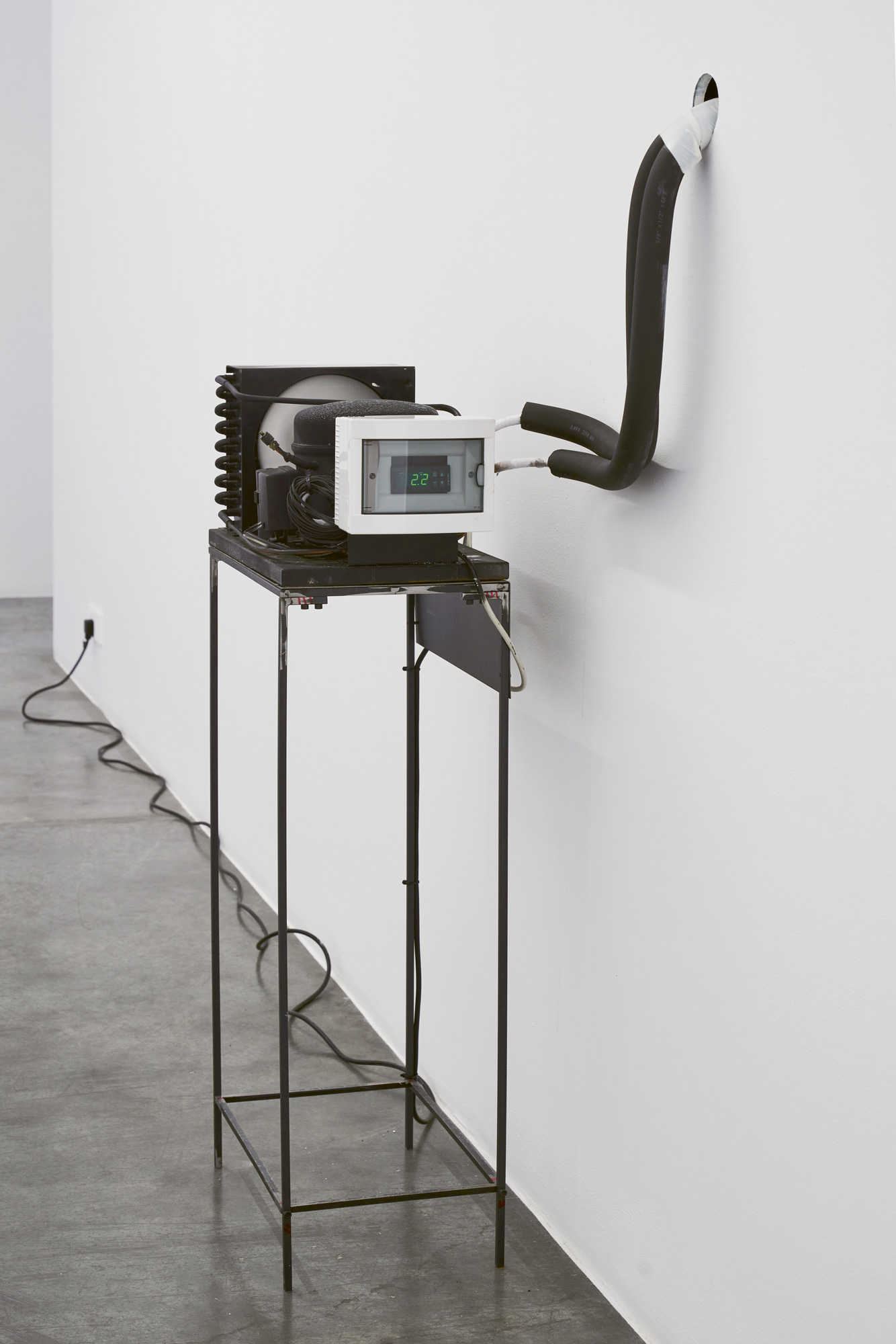
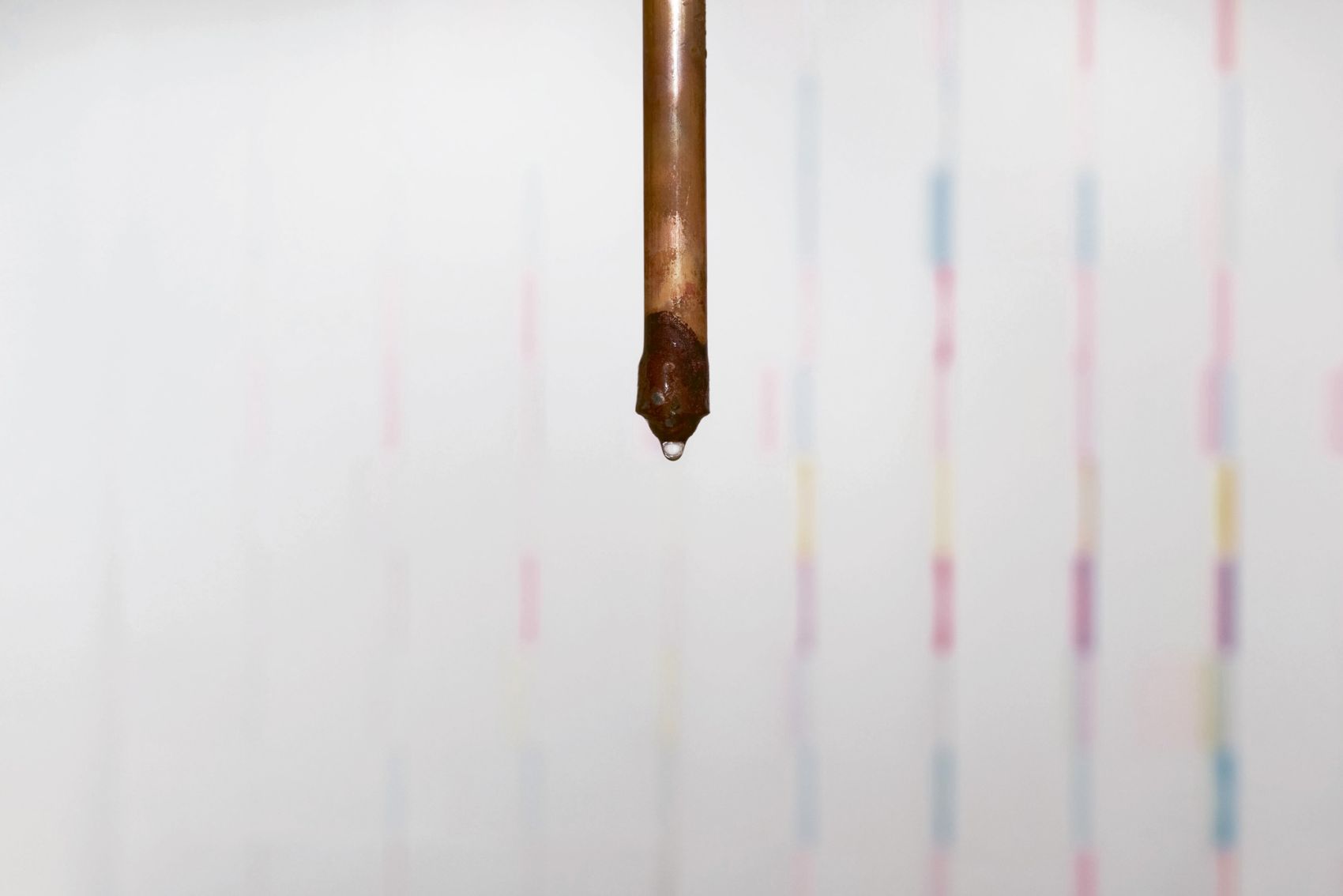
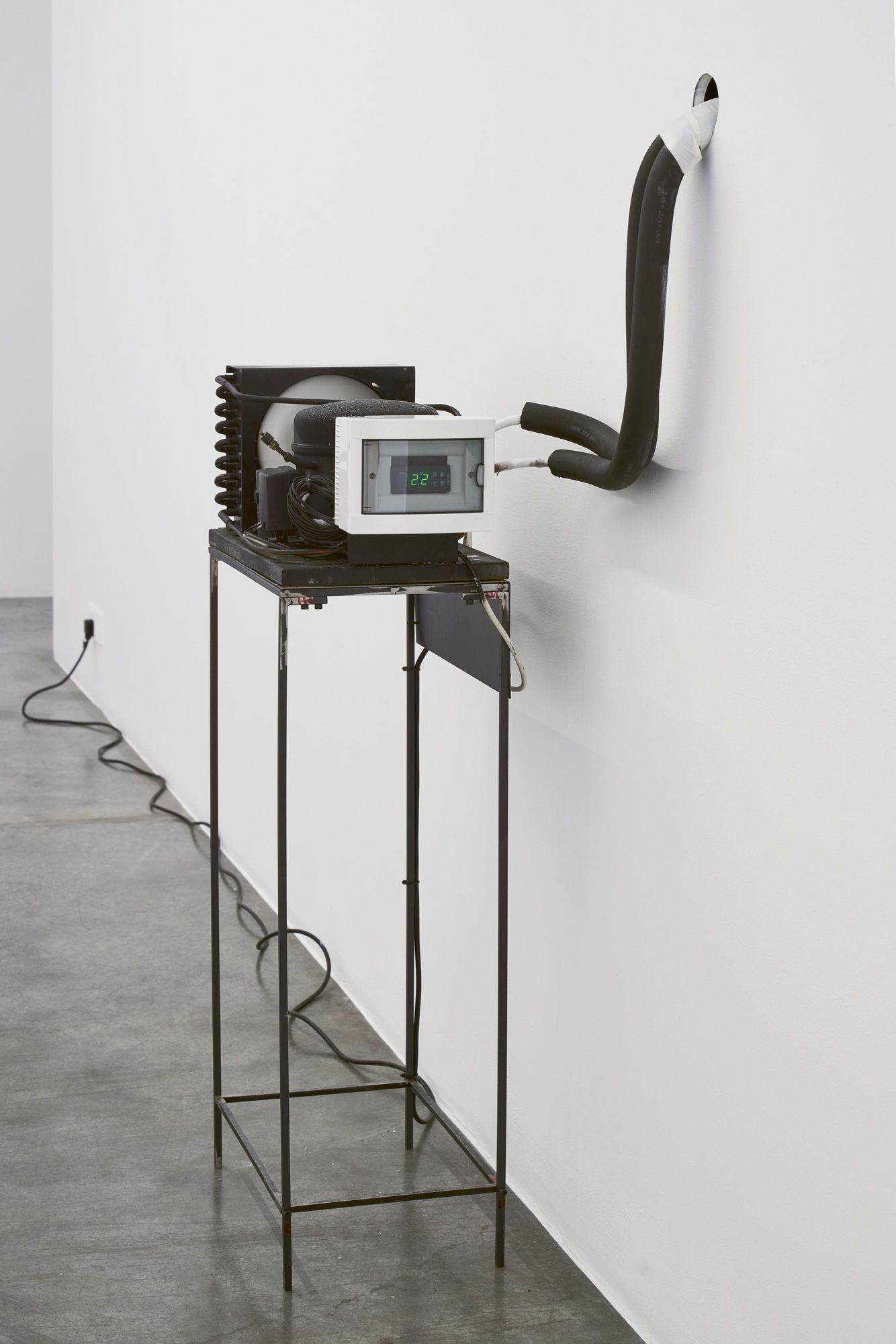
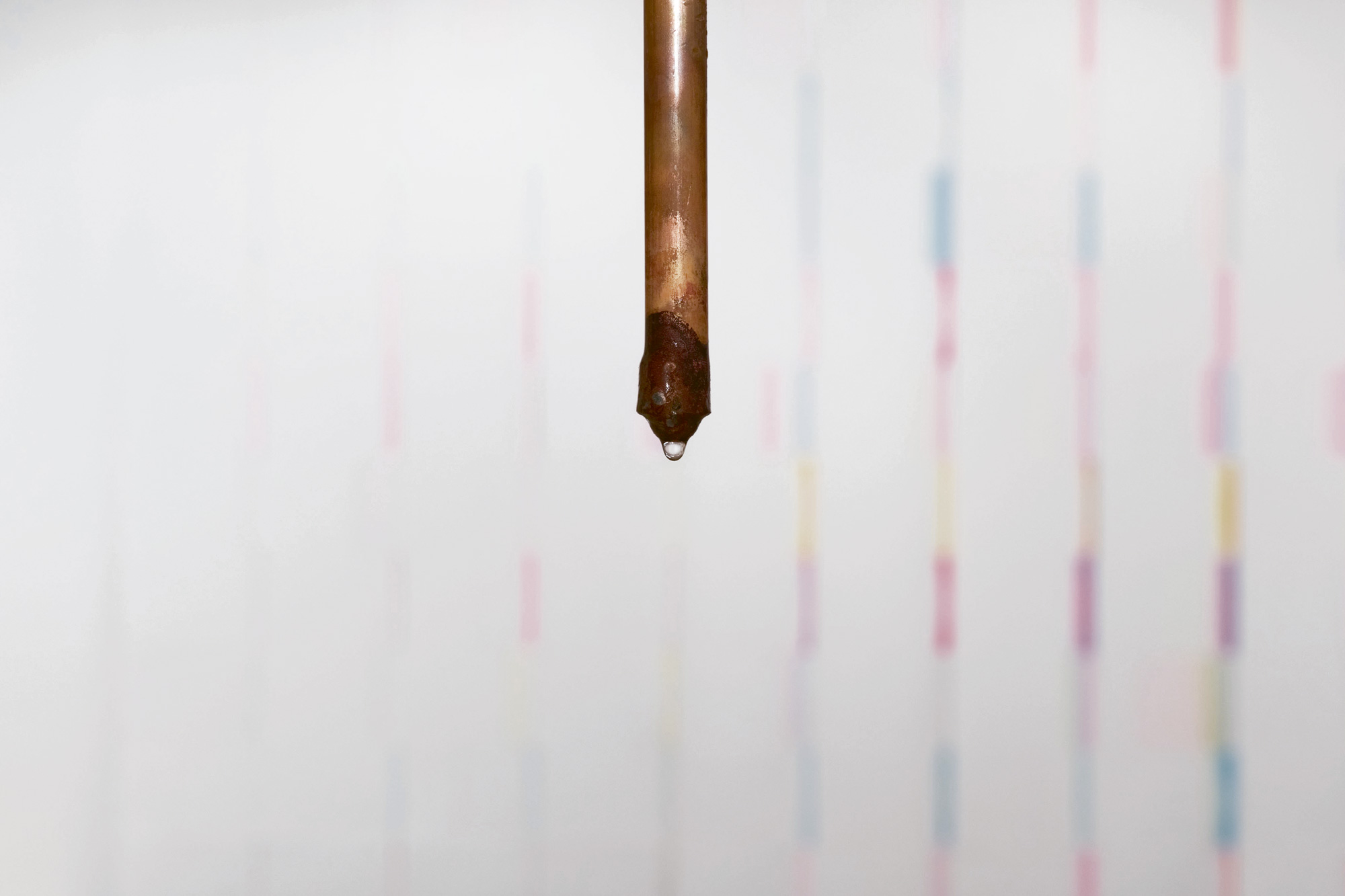
The Kinetics of the Invisible, 2019, Courtesy the artist and Marfa’ Projects, photo: Mathias Schormann

The Kinetics of the Invisible, 2019, Courtesy the artist and Marfa’ Projects, photo: Mathias Schormann

Droplets

Suspended from the ceiling, a copper pipe is cooled by a compressor. Moisture from the ambient air condenses on its surface, gathers into droplets, and falls into a container below. What becomes visible is a process that usually remains unseen: the transition from air to water.

Copper functions here as a conductive material, absorbing temperature differentials and translating them into a perceptible form. The work brings together technical apparatus and elemental process. It is neither a sculpture in the classical sense nor merely a device, but an experimental arrangement in which exchange takes place: between air and surface, between cooling and condensation, between the surrounding climate and form.

The title Breathing Surface refers to this porous relationship between material and environment. The surface appears to breathe as it absorbs, condenses and releases. In doing so, the work establishes a fundamental principle of the exhibition as a whole: states are not fixed, but emerge through interaction. It marks the beginning of a cycle in which materials undergo continuous transformation.

Room 2

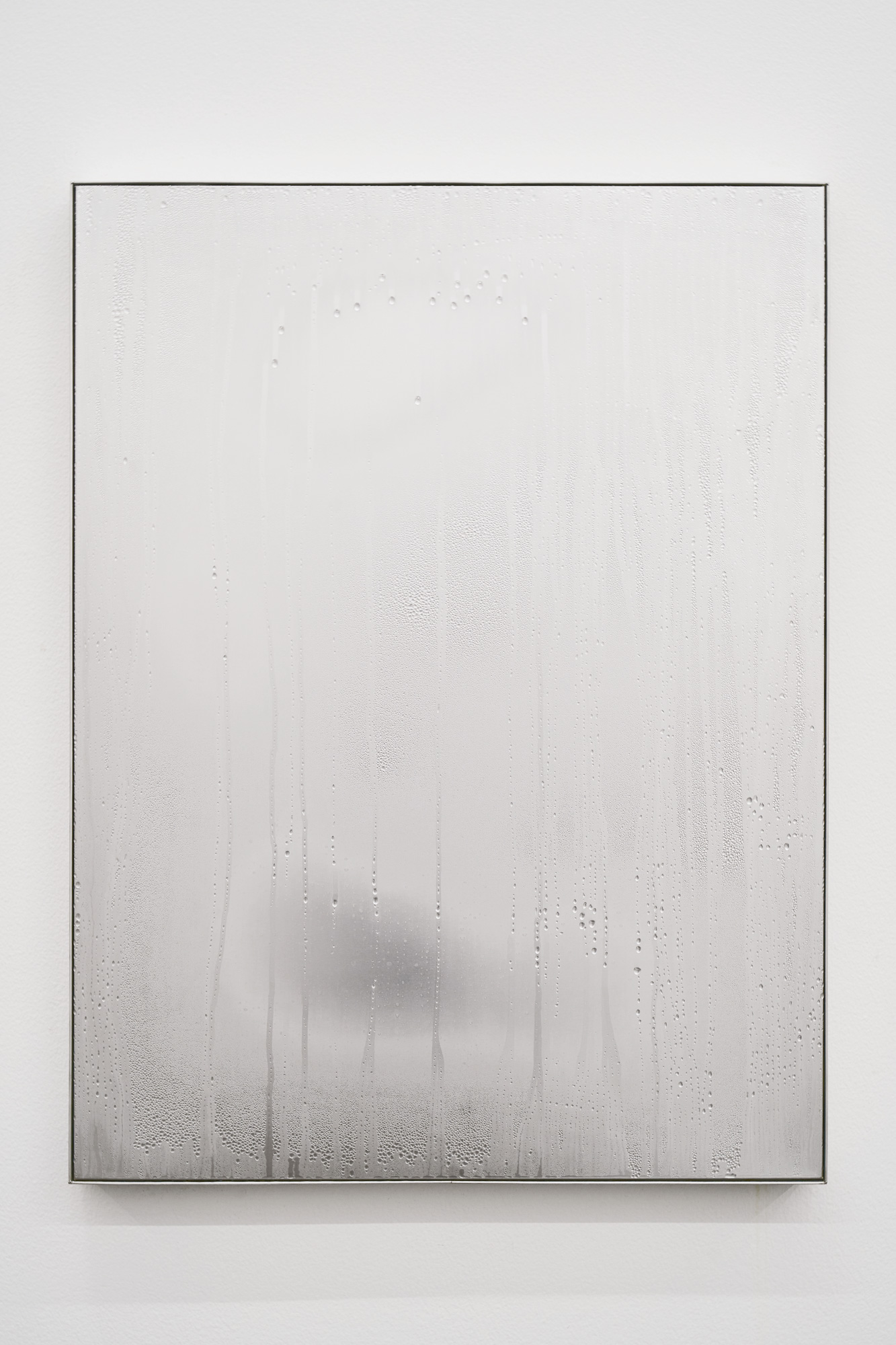
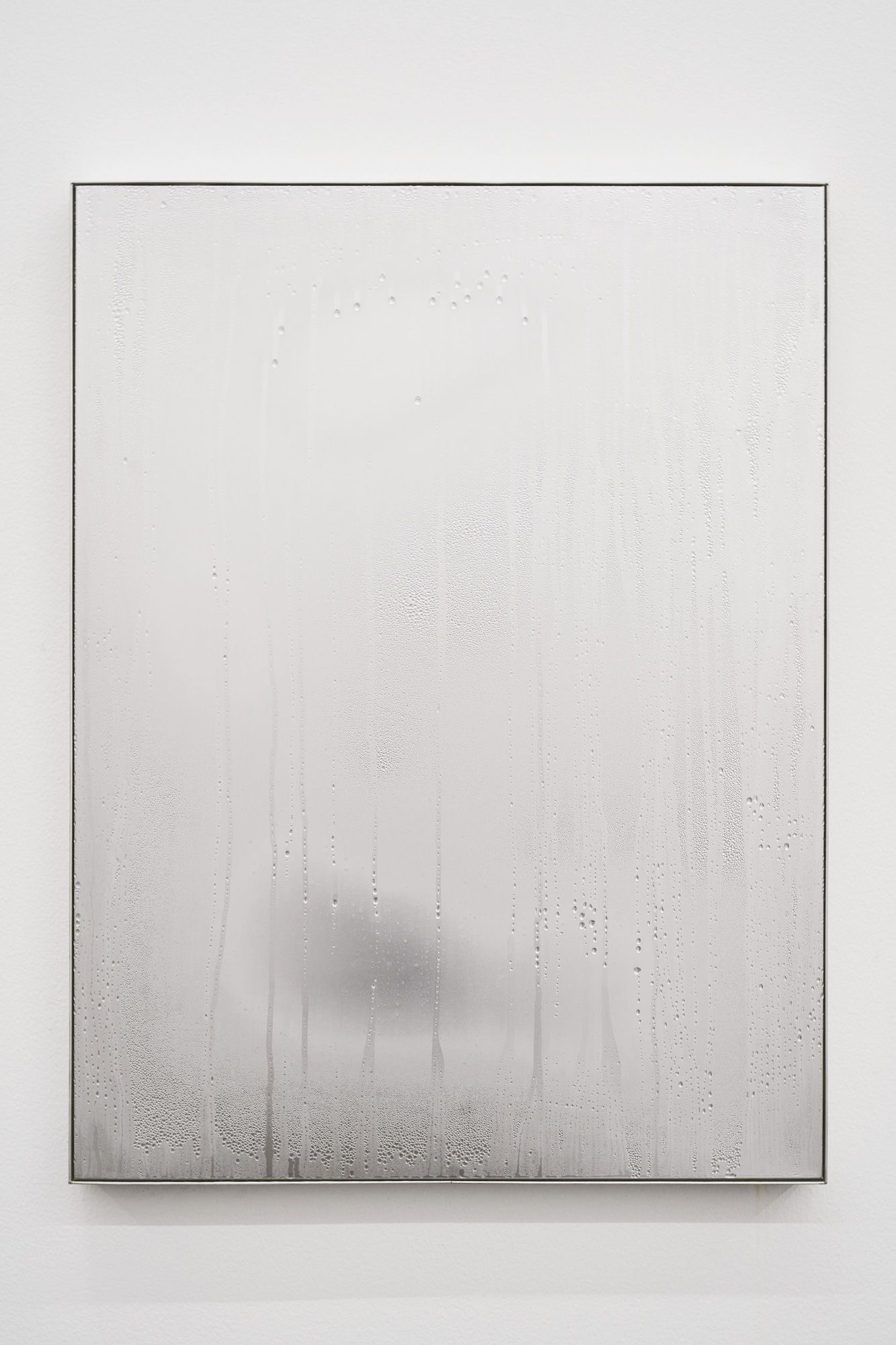
Condensations of the Invisible Space (detail), 2021, courtesy the artist, Marfa’, Beirut and Grey Noise, Dubai, Foto: Musthafa Aboobacker

Condensations of the Invisible Space (detail), 2021, courtesy the artist, Marfa’, Beirut and Grey Noise, Dubai, Foto: Musthafa Aboobacker

Dew

In this room, water does not only appear as an artistic material, but as a consequence of the existing conditions. Condensation forms on stainless steel surfaces in response to temperature, humidity and cooling. The work renders visible an infrastructural process that usually escapes perception. Water does not appear as image or sign, but as an event at the surface.

The metal panels recall monochromes in their appearance. Yet their apparent uniformity is disrupted by moisture. Droplets, mist and freezing transform the smooth surface into a field of shifting states. The surface is not passive, but a site of exchange between material and environment. The work demonstrates that industrial materials respond to their surroundings and retain a form of memory.

The title Electric Dew brings together a natural phenomenon and a technical system. Dew appears here not outdoors, but within a constructed situation. In doing so, the work reframes the conditions of visibility. Through its use of stainless steel, the same material as the façade, the work draws the outer skin of the Kunstmuseum into the interior and translates climate into form. What becomes visible is the fragile balance in which water fluctuates between states of matter and manifests as moisture.

Room 3

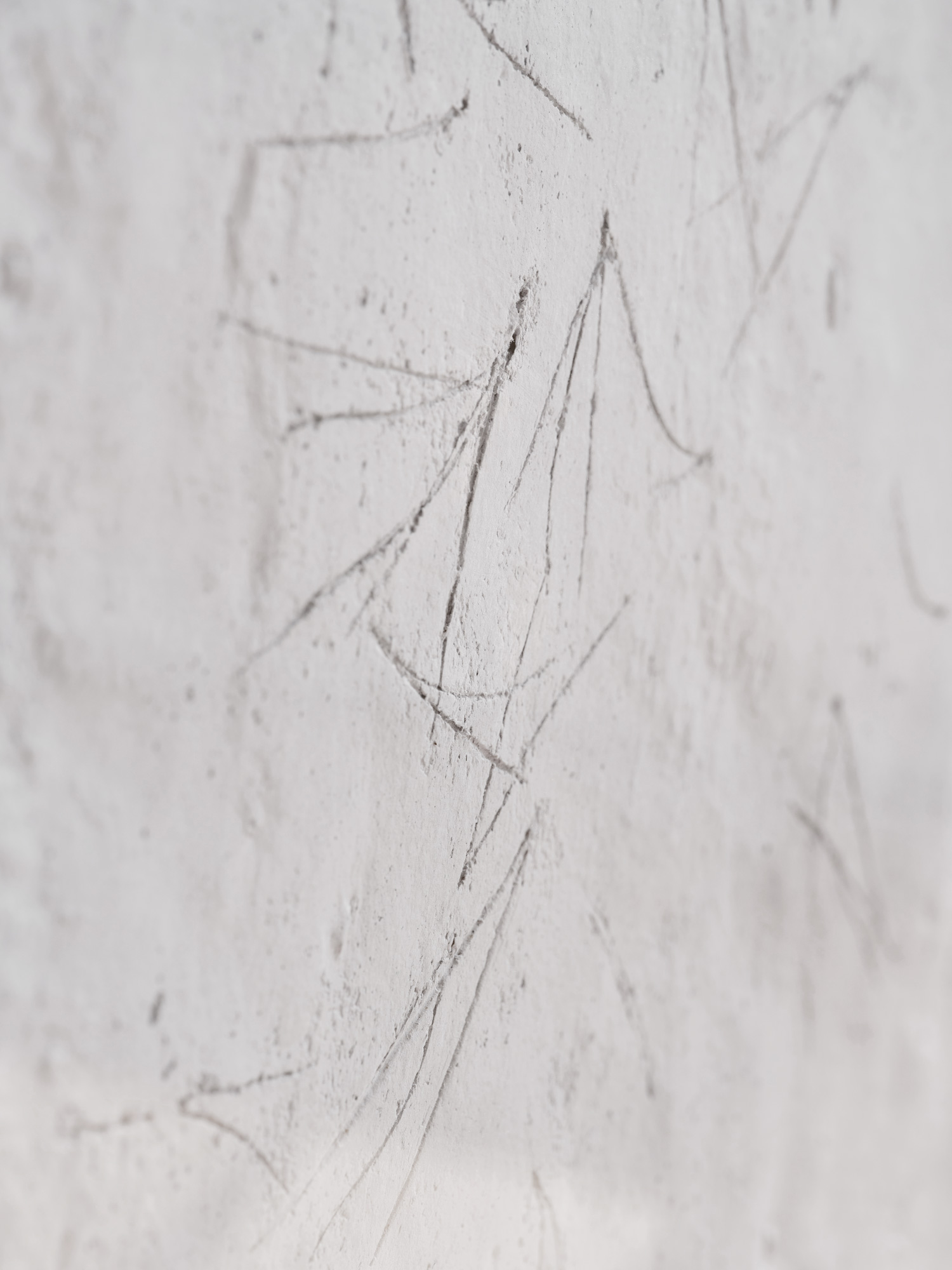
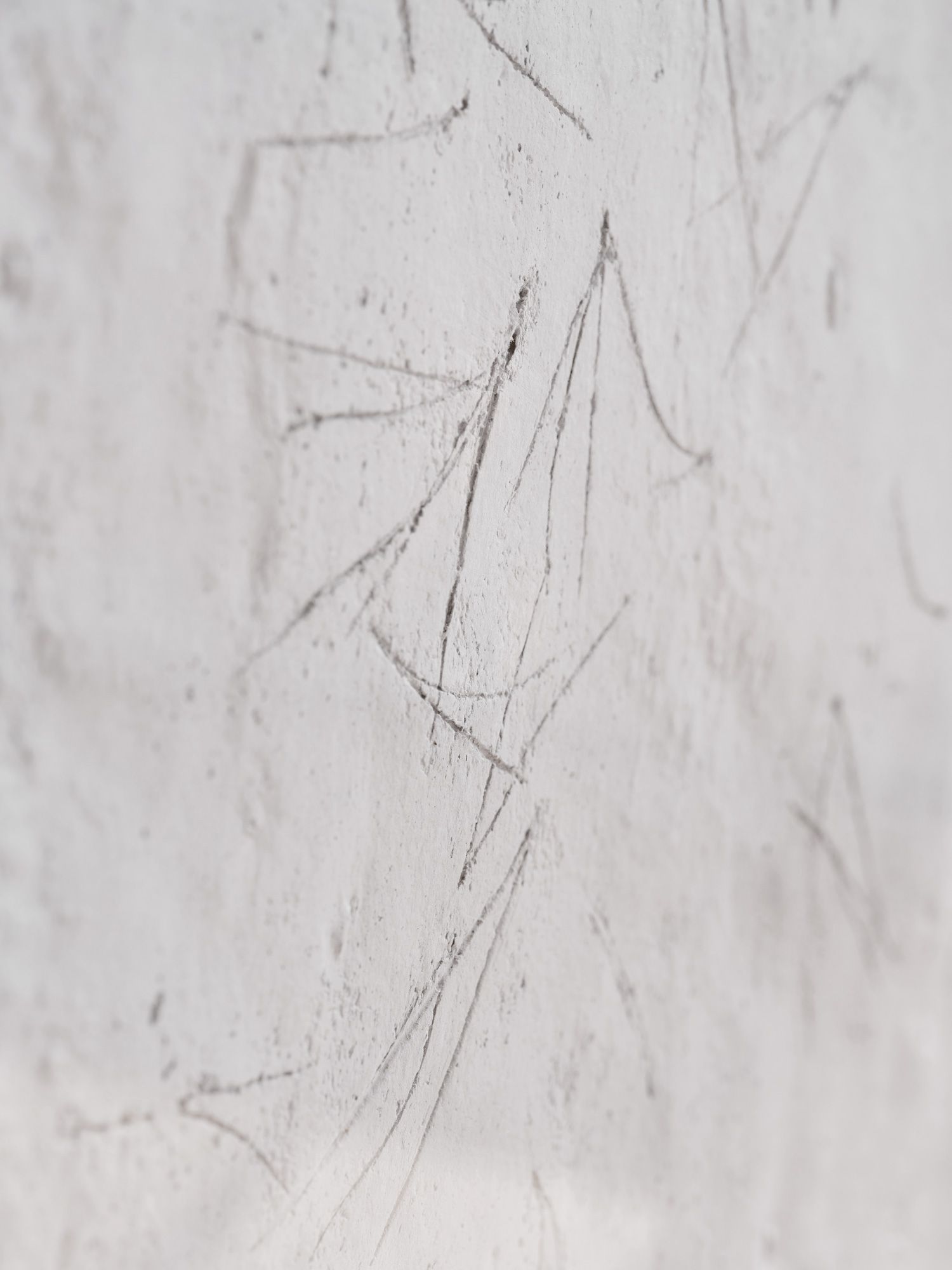
Measuring Entropy (detail), 2023, Courtesy the artist and Marfa’ Projects, photo: Ros Kavanagh

Measuring Entropy (detail), 2023, Courtesy the artist and Marfa’ Projects, photo: Ros Kavanagh

Sedimentation

The works The Surface Remembers shift attention from the condensation of water to the inscription of time. These works on paper, into which pine needles are embedded, are based on contact, pressure and accumulation. The organic material leaves its trace directly within the work. What emerges are not images in the conventional sense, but imprints that register duration, decay and touch.

The pine needles originate from a specific landscape and carry its material memory. At the same time, they lose any symbolic legibility within Aoun’s work. They do not function as a reference to nature, but as operative elements within a process. The paper becomes a site of temporal sedimentation: something has rested upon it, has fallen, has pressed, has retained heat.

The title The Surface Remembers precisely describes this logic. The surface is not an endpoint, but a repository. It retains traces of proximity, layering and transformation. The works thus exist between fossil, imprint and drawing. They make visible that memory does not reside solely in imagery, but in material states themselves. Here, the exhibition moves from atmospheric condensation to the material inscription of time.

Room 4

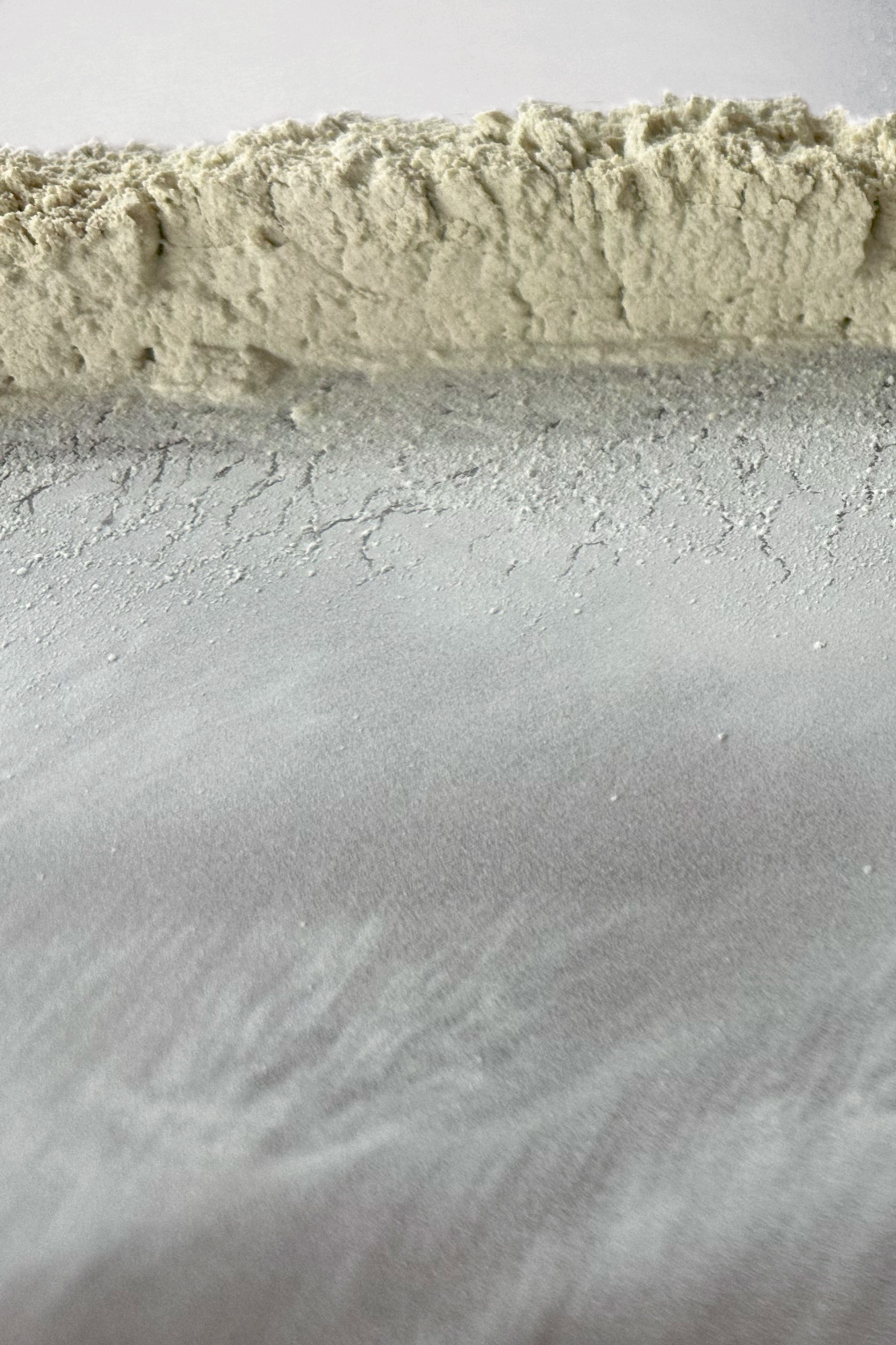
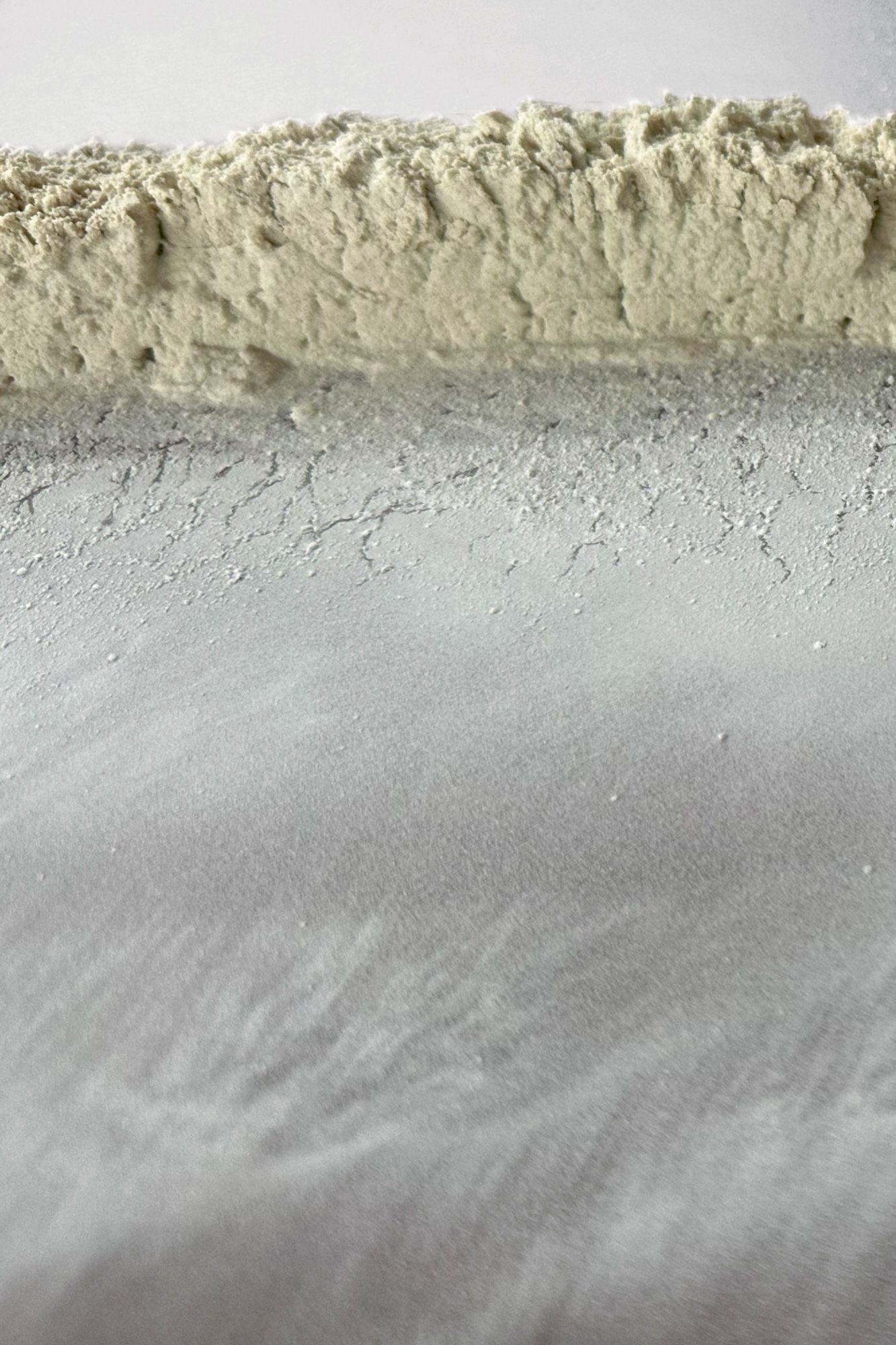
After the Water (Or Evaporation Field), 2026, courtesy the artist, commissionned by Kunstmuseum Appenzell, production photo Caline Aoun

After the Water (Or Evaporation Field), 2026, courtesy the artist, commissionned by Kunstmuseum Appenzell, production photo Caline Aoun

Evaporation

At the centre of the room, water emerges as a shaping force. From a single point, it spreads through cement and limestone powder, permeating the material, evaporating, and leaving behind a hardened ring. What becomes visible is not the water itself, but its afterlife: the trace of its movement. The work presents a state after the event, in which dispersal, absorption and drying can be read simultaneously.

Cement and limestone respond differently to moisture. Evaporation is thus understood not as an abstract process, but as one that alters surfaces and produces distinct material states. The circular formation recalls sediment, mineral deposit or a geological field. At the same time, it remains grounded in a simple physical fact: water spreads, seeps, evaporates and binds.

The title After the Water refers to a moment in which the liquid element is no longer present, yet continues to determine everything. The work compresses geological and everyday time into a perceptible form. The room becomes a field of slow transformation, in which change unfolds not dramatically, but quietly and continuously.

Room 5

Condensations of the Invisible Space, 2023, Courtesy the artist and Marfa’ Projects, photo: Musthafa Aboobacker

Condensations of the Invisible Space, 2023, Courtesy the artist and Marfa’ Projects, photo: Musthafa Aboobacker

Condensation

Condensation returns in this room, though in a modified form. Moisture registers differently across surfaces that have been treated in distinct ways. The work demonstrates that even seemingly neutral, industrial materials inscribe their properties and memories into the process.

Dreaming of Electric Dew revisits a phenomenon introduced earlier. Condensation appears here as a fine, temporary drawing, emerging from the interplay of temperature, humidity and material composition.

The room condenses the logic of the preceding works: perception arises from minimal differences. The same atmospheric condition produces distinct images. The work renders these variations perceptible and once again shifts attention to how material and environment shape one another.

Room 6

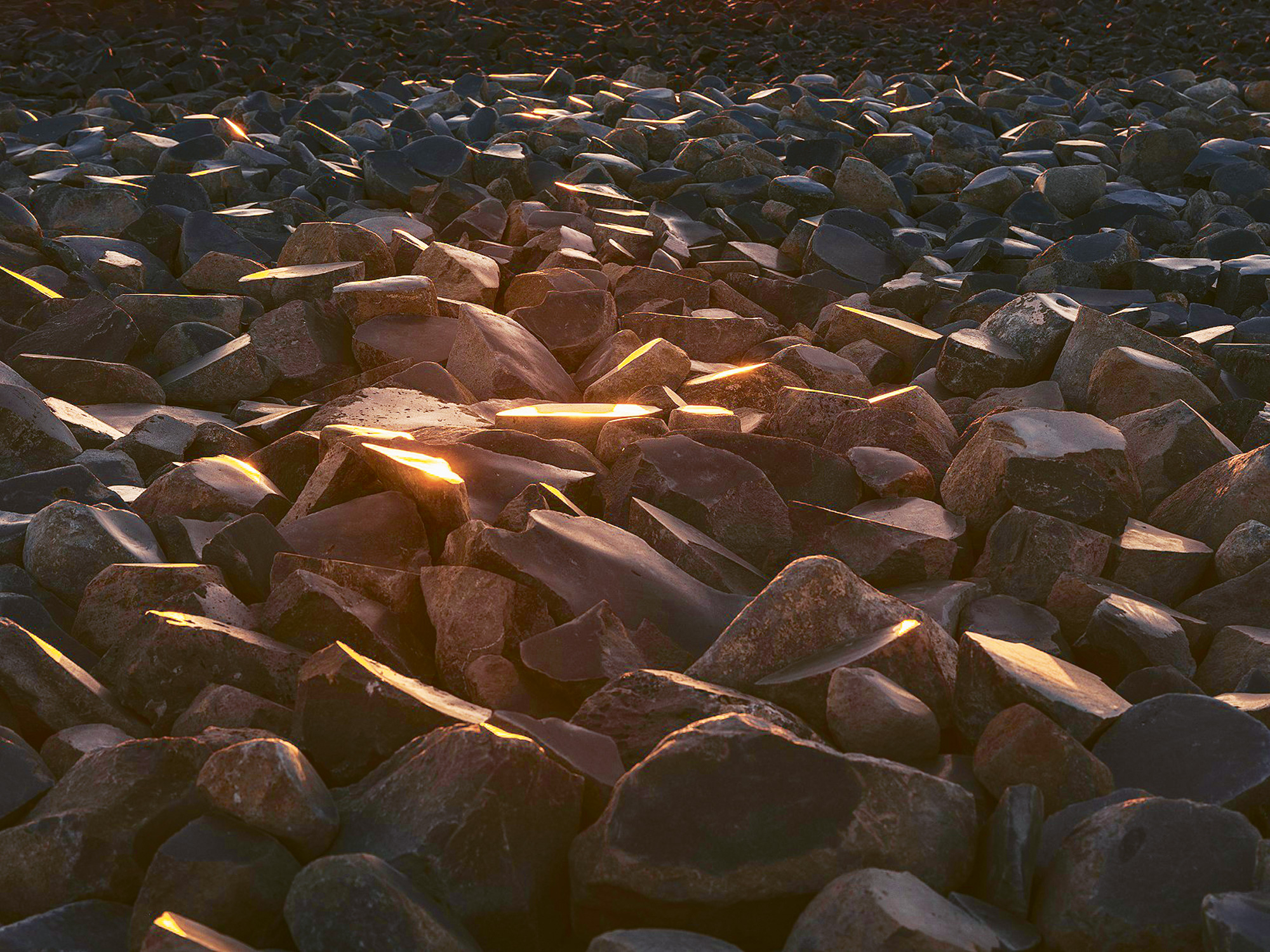
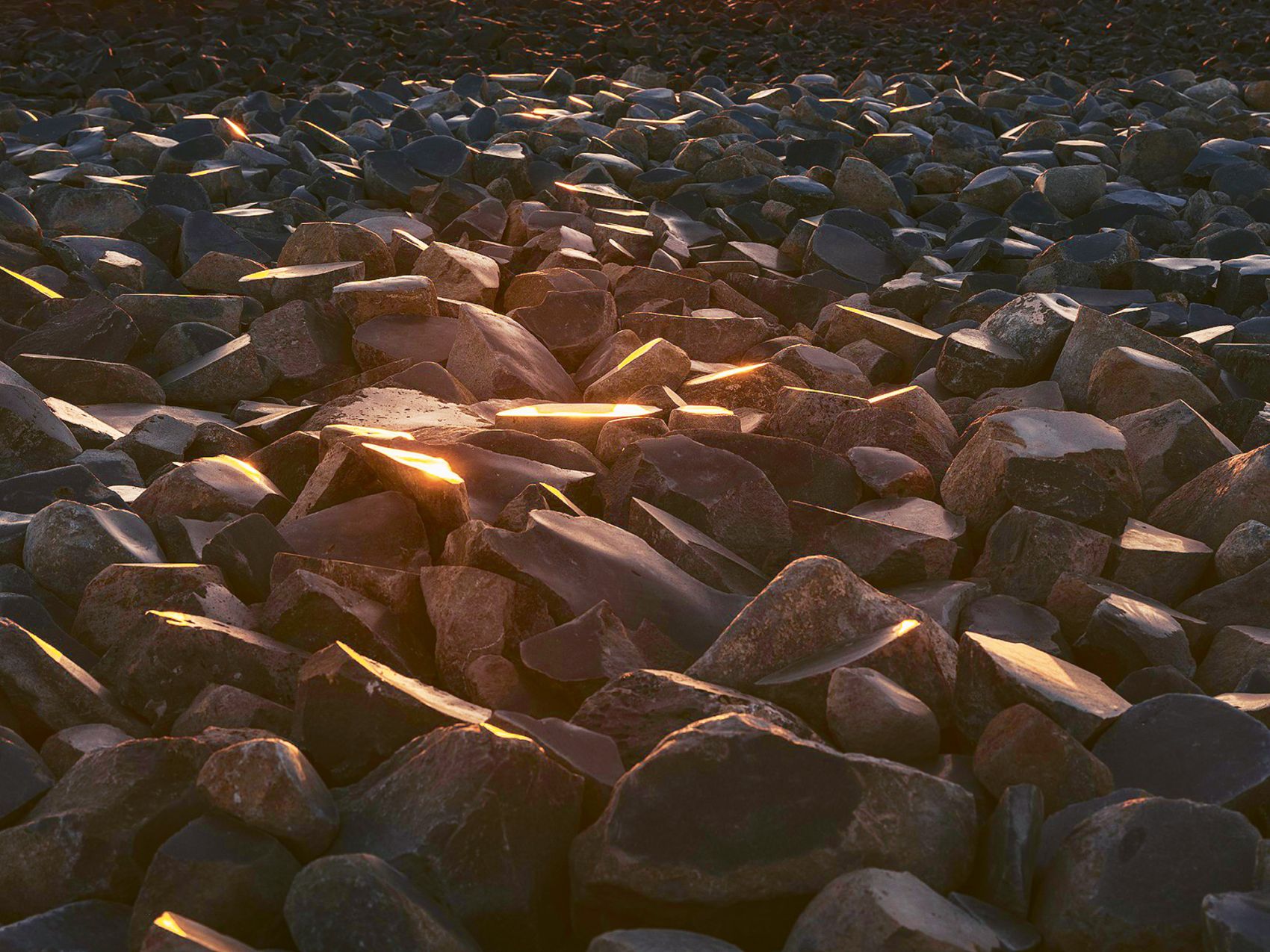
The Desert Has No Surface (detail), 2024, courtesy of The Royal Commission for AlUla, photo: Lance Gerber

The Desert Has No Surface (detail), 2024, courtesy of The Royal Commission for AlUla, photo: Lance Gerber

Light

With this room, the exhibition shifts from water and cold to light and heat. Polished stones respond to both natural and artificial illumination, altering their appearance in relation to time of day, the angle of light and the movement of viewers. The surface reflects the light and generates an unstable visual field that continually reconfigures itself as conditions change.

At first glance, the stones appear calm and self-contained. Only in passing does it become apparent how strongly their appearance depends on situational factors. Reflections glide across the surface, dissolving contours and at times rendering the stone almost immaterial. Light is not treated here as a neutral means of visibility, but as an active component of the work.

Holding Light describes this precarious relationship between material and appearance. The stone does not hold light, but allows it to emerge only temporarily. Perception thus becomes a time-bound process. The work extends earlier projects by Aoun in which polished stone surfaces become visible only under specific conditions, translating this logic into the interior of the museum.

Room 7–8

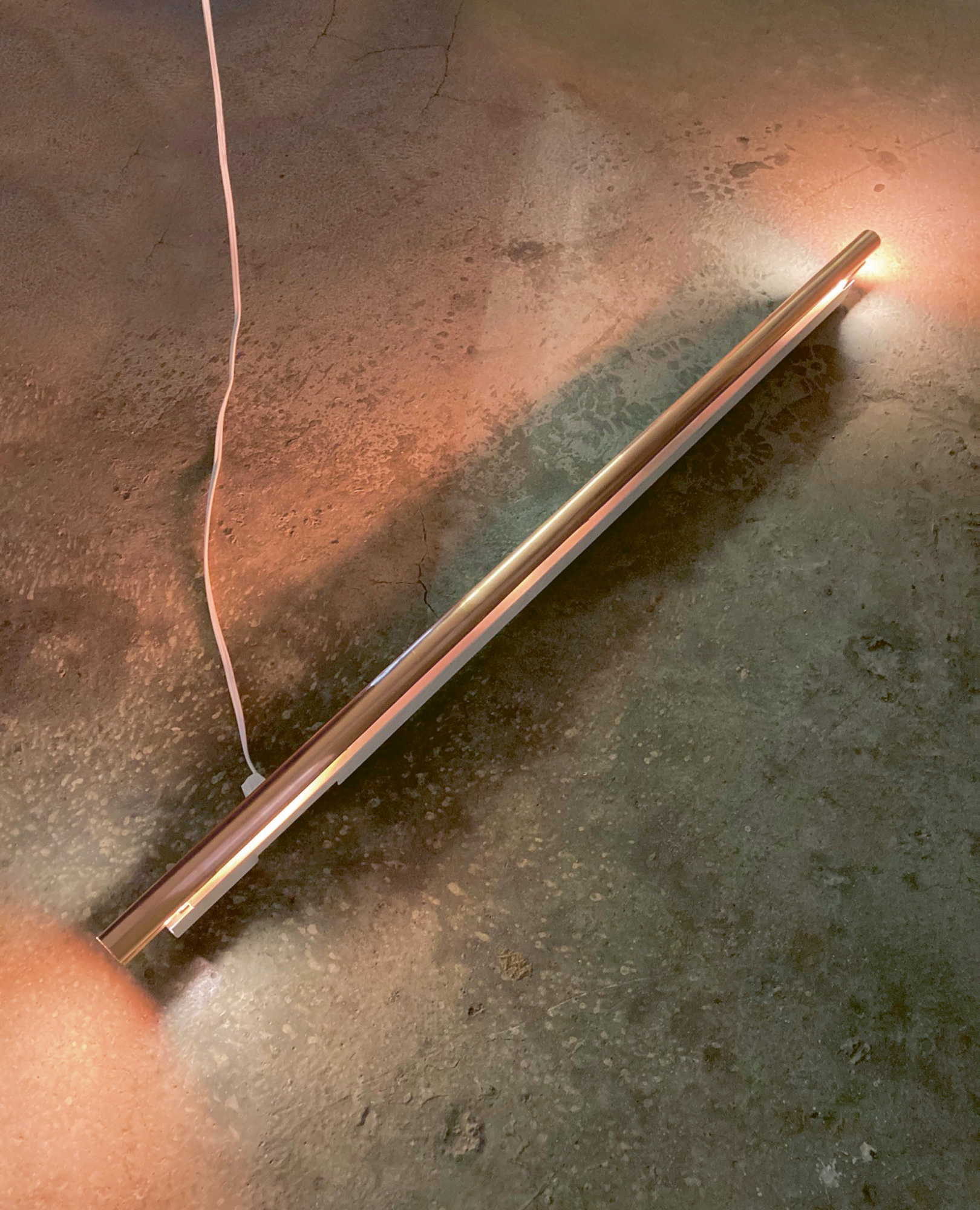
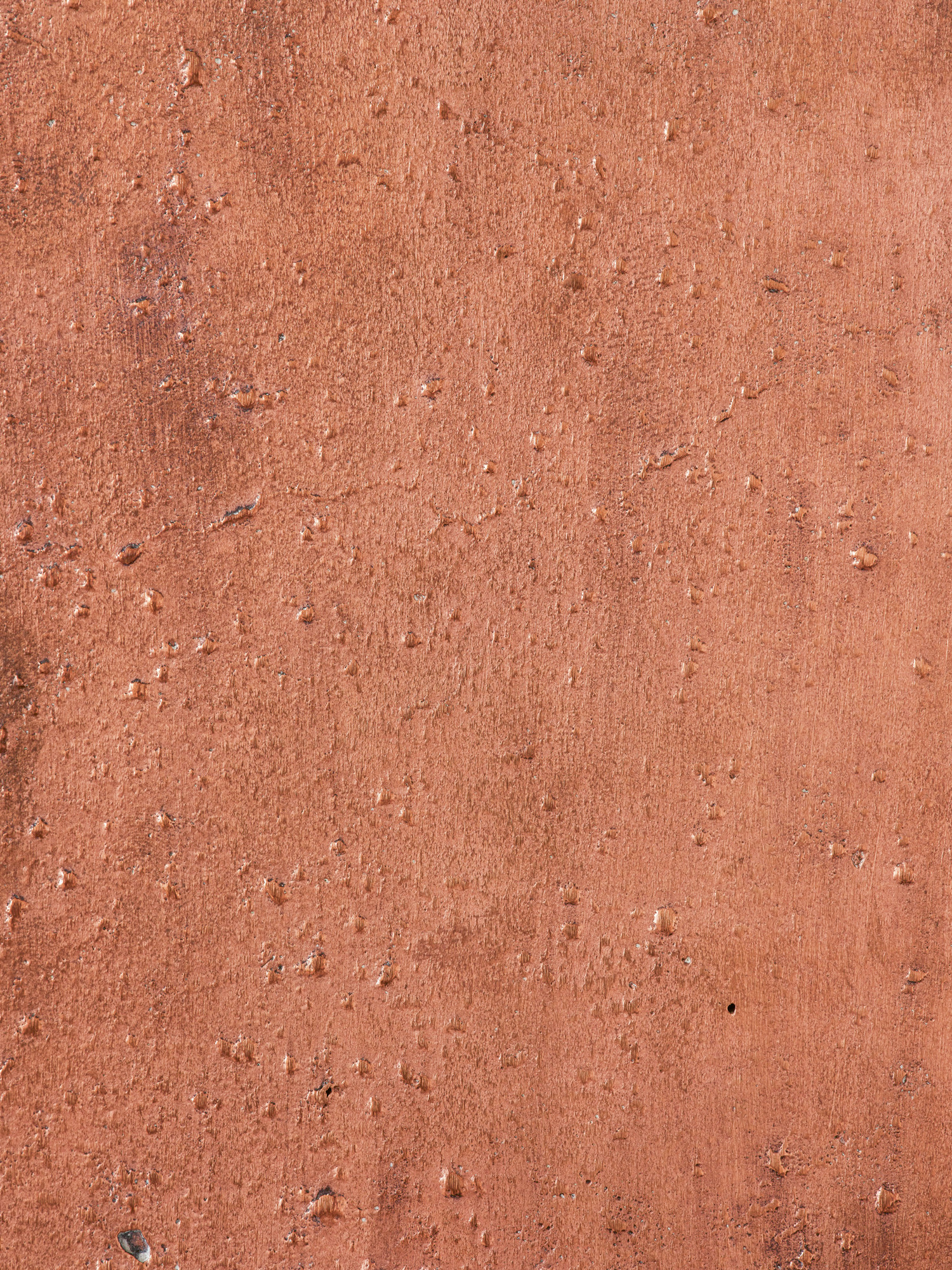
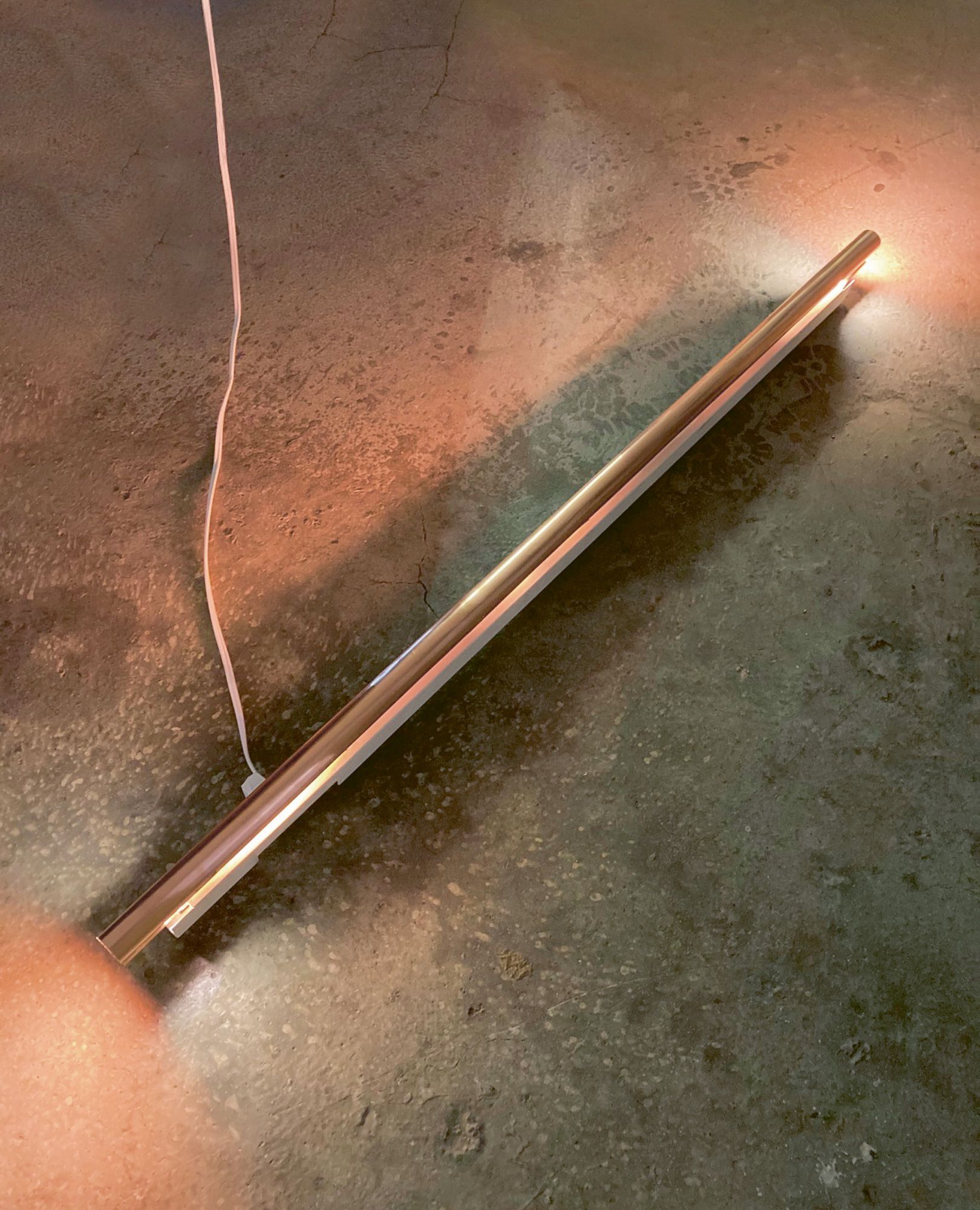
Radiant Alchemy, 2023, Courtesy the artist and Marfa’ Projects, photo: Youssef Itani

Radiant Alchemy, 2023, Courtesy the artist and Marfa’ Projects, photo: Youssef Itani

Warmth

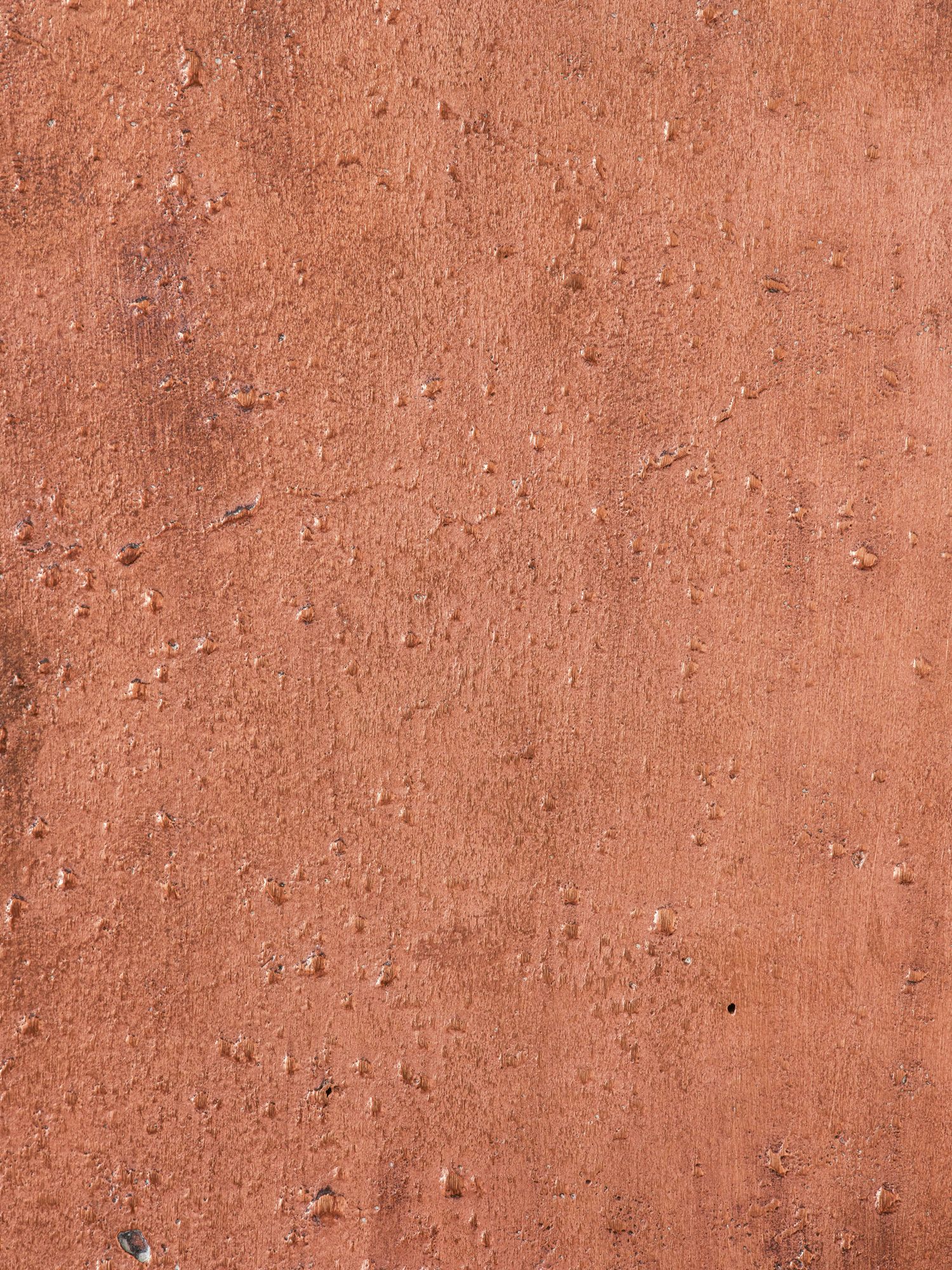
In Rooms 7 and 8, light is detached from its architectural function. The museum’s lighting fixtures are removed from the ceiling, encased in copper and placed on the floor. Light no longer disperses evenly throughout the space, but is converted into heat through the conductive material. The work thus renders energy visible while, at the same time, making it physically perceptible.

Copper absorbs and conducts. In place of conventional illumination, a thermal presence emerges, perceived through proximity and touch. The lighting fixtures become visible within the museum’s neutral infrastructure and appear as active components within an energetic system. Architecture is translated into material and climate.

The title Emanating Ground refers to this inversion. What would normally come from above is now located on the floor; what is typically perceived as light manifests as heat. These rooms mark a point of transition within the parcours: from atmospheric and optical phenomena towards a direct physical experience of energy. Perception is organised thermally, rather than solely visually.

Room 9

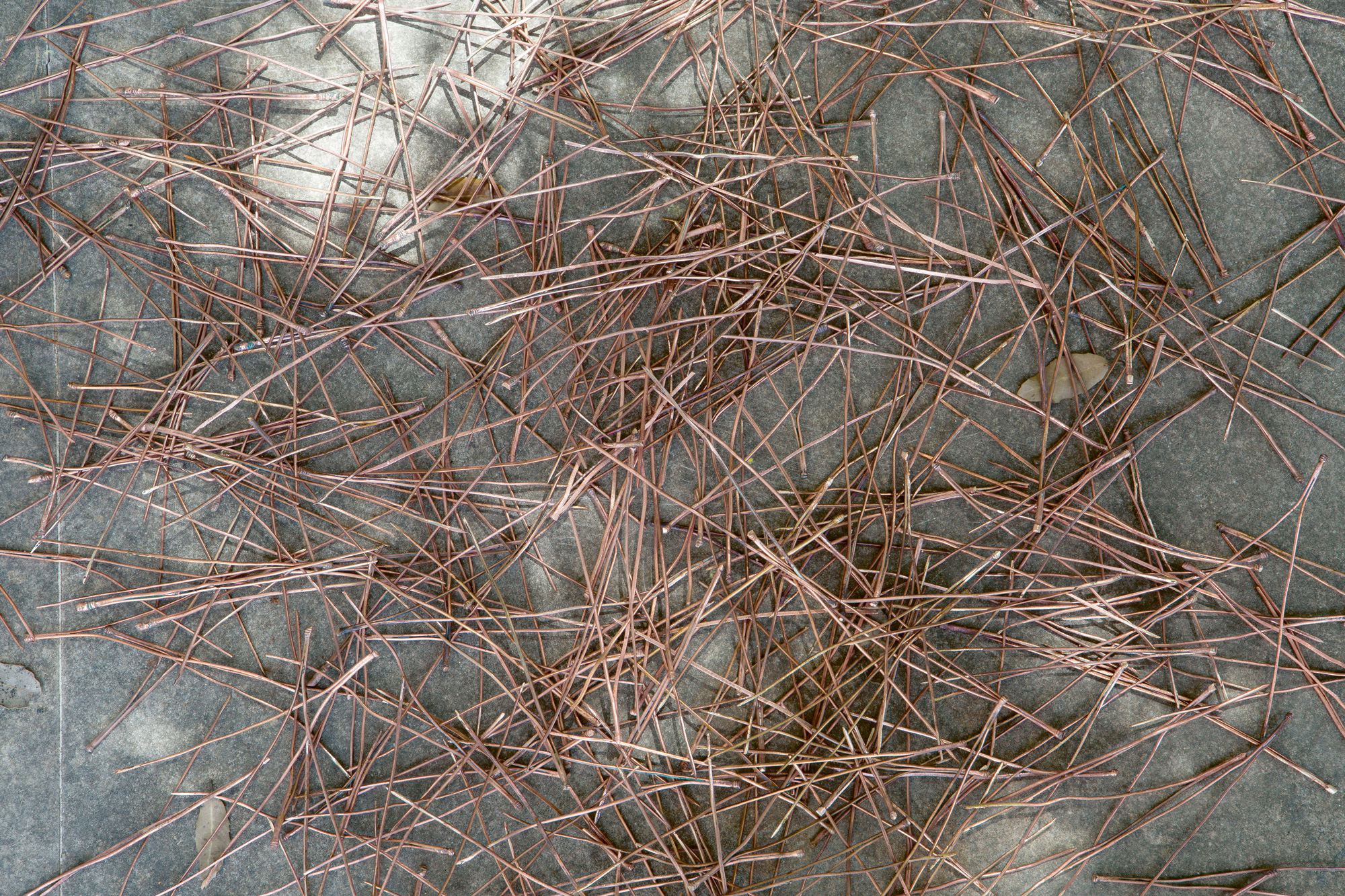
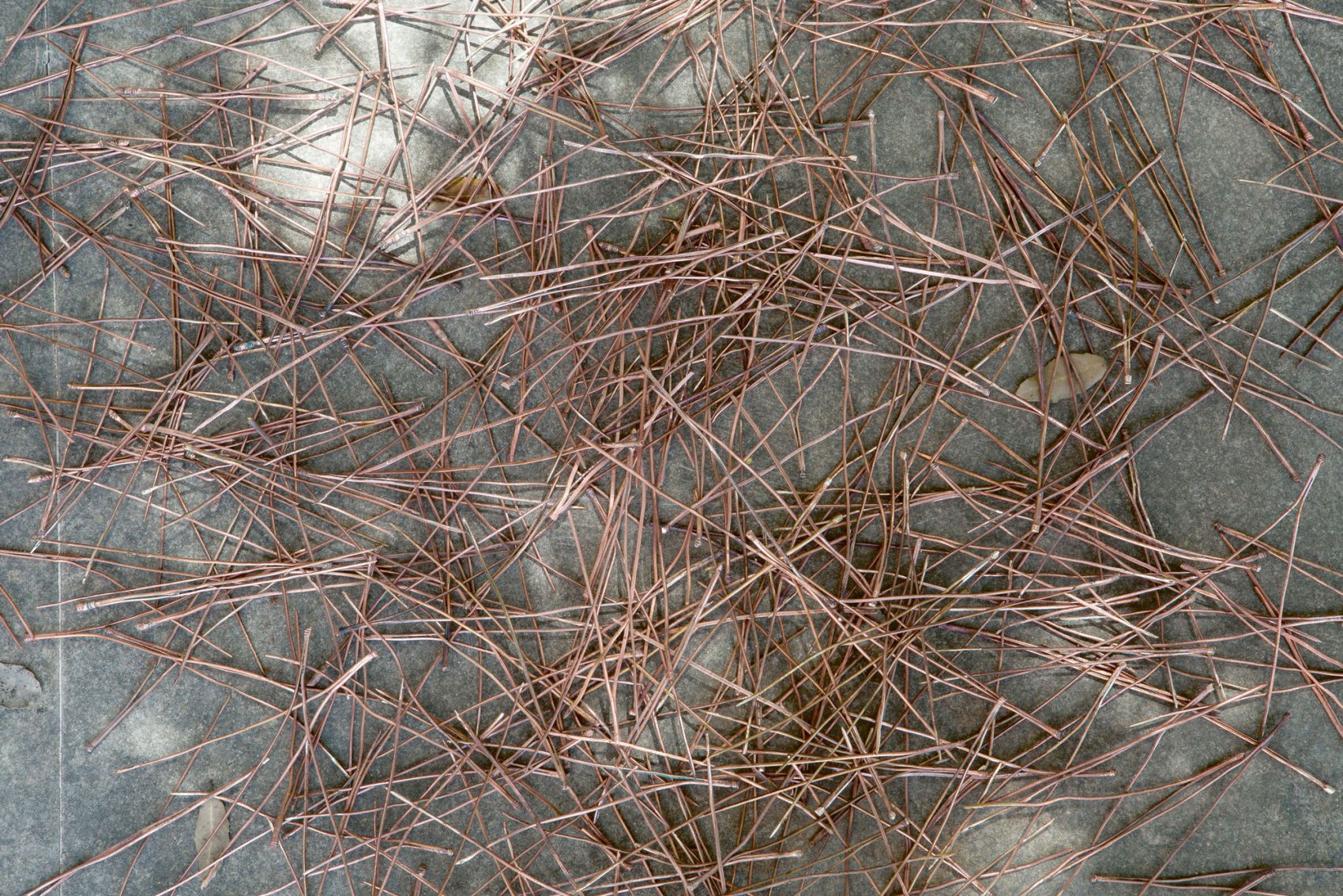
Pine Needles, 2015, courtesy The Museum of Fine Arts, Houston, museum purchase funded by Chris Urbanczyk, with matching funds from Chevron, and by the Museum Collectors, photo: Caline Aoun

Pine Needles, 2015, courtesy The Museum of Fine Arts, Houston, museum purchase funded by Chris Urbanczyk, with matching funds from Chevron, and by the Museum Collectors, photo: Caline Aoun

Residue

The pine needles return in a modified form. Cast in copper and darkened through oxidation, the needles lie scattered across the floor. They appear as remnants of a past process – no longer active or conductive, but as deposits and afterimages of heat. Whereas the copper works in the preceding rooms set energy in motion, here it seems already spent.

The organic form remains recognisable, yet has been translated into metal. In doing so, both material properties and temporality shift. What was once light, dry and transient now appears heavier, darker and more enduring. This does not, however, suggest stability. Rather, the oxidised surfaces point to another kind of process: chemical transformation, discolouration, the gradual dissipation of energy.

Pine Needles reads as an echo of Room 3. The trace of the organic is no longer inscribed in paper, but fixed in metal. The room thus addresses what remains after a process of transfer. The immediacy of the heat has faded; what becomes visible is its residue.

Room 10–11

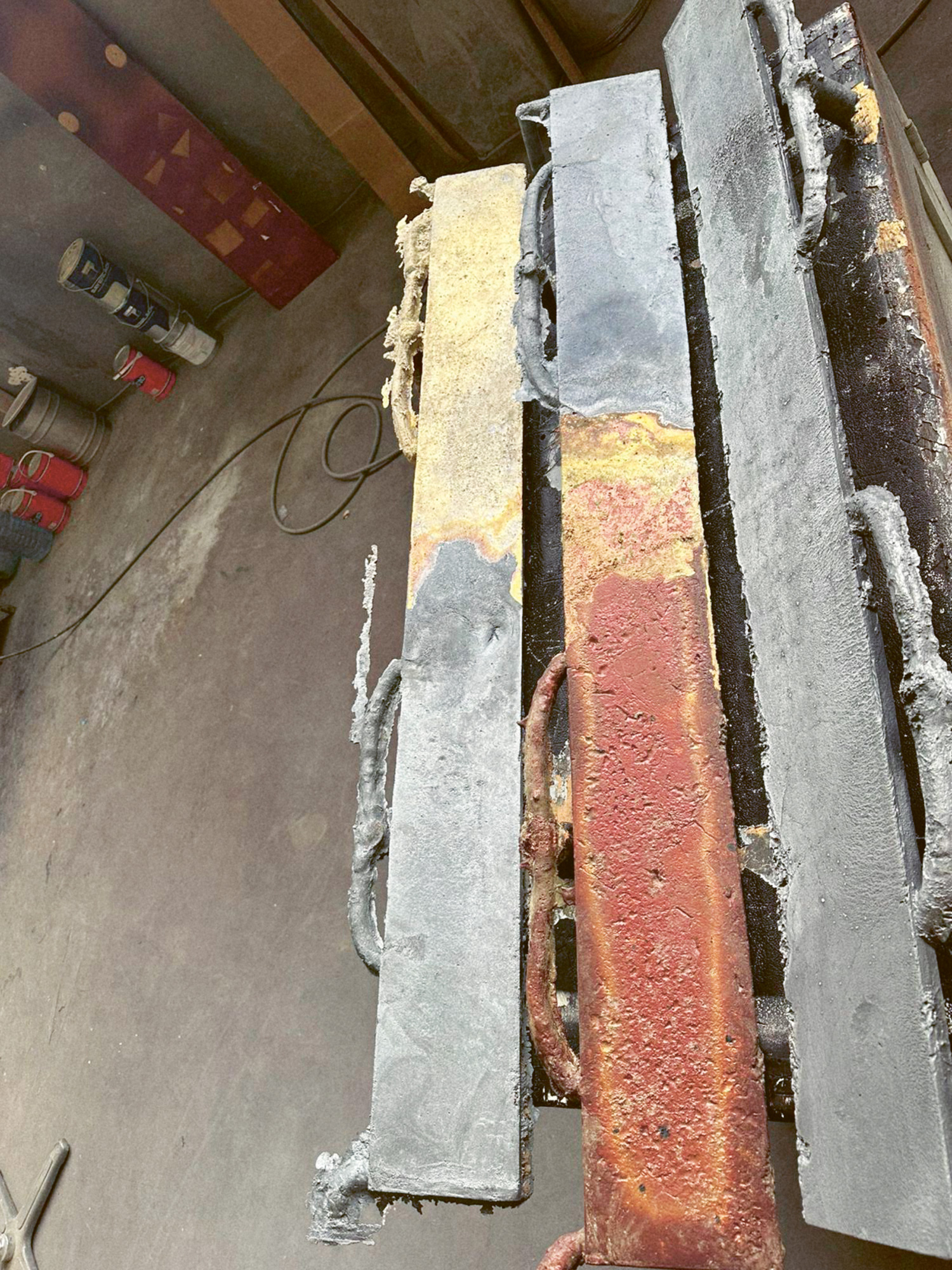
Colliding Forces, 2026, courtesy the artist, commissionned by Kunstmuseum Appenzell, production photo: Caline Aoun

Colliding Forces, 2026, courtesy the artist, commissionned by Kunstmuseum Appenzell, production photo: Caline Aoun

Heat

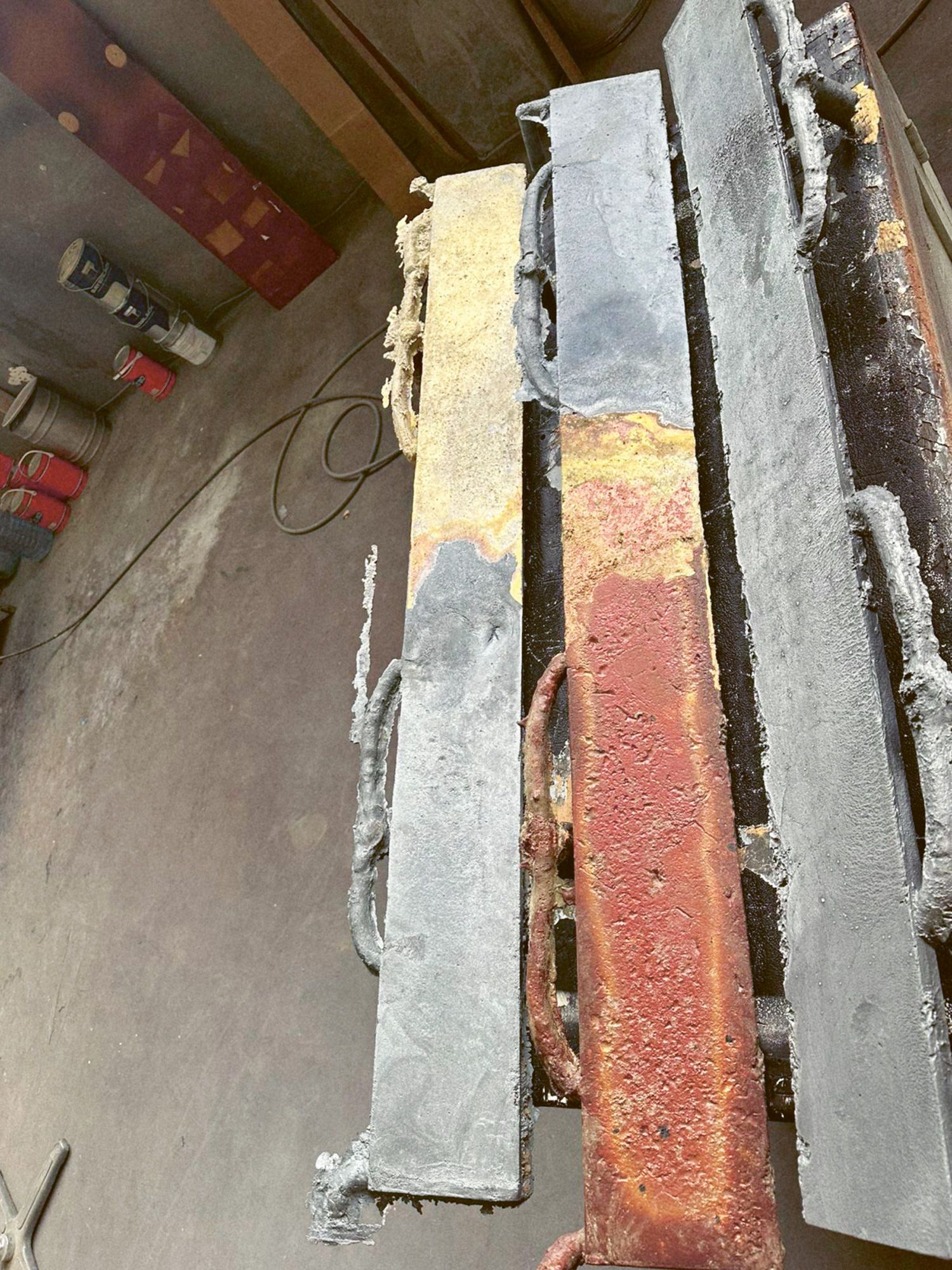
At the end of the parcours, the exhibition reaches a state of maximum intensity. In Rooms 10 and 11, metals meet in a molten state. Their encounter is fixed at the moment of cooling and solidification. What becomes visible is an uncontrolled end product, a state of extreme instability that has solidified in the process of cooling.

The work is conceived less as a conventional act of metal casting than as an investigation into forces acting upon matter. Two metals with different melting points come into contact in their liquid state and, upon solidifying, form not a clean seam but a turbulent transitional zone. Fluid transitions, veins, eddies and gradual shifts emerge – forms that recall geological strata deformed by heat and pressure.

The work brings together central motifs of the exhibition: heat, material transformation, time and threshold. Unlike earlier rooms, where processes unfold slowly and almost imperceptibly, transformation appears here as collision. Material does not remain self-contained, but enters a condition in which form can only be understood as the result of energetic forces.

Colliding Forces marks the culmination of the parcours at the Kunstmuseum. Following condensation, evaporation, reflection and heat conduction, irre-versible transformation occurs. The work makes clear that matter does not appear as a stable given, but as something that, under certain forces, loses and reconstitutes its form – a moment in which one state gives way to another.
Window

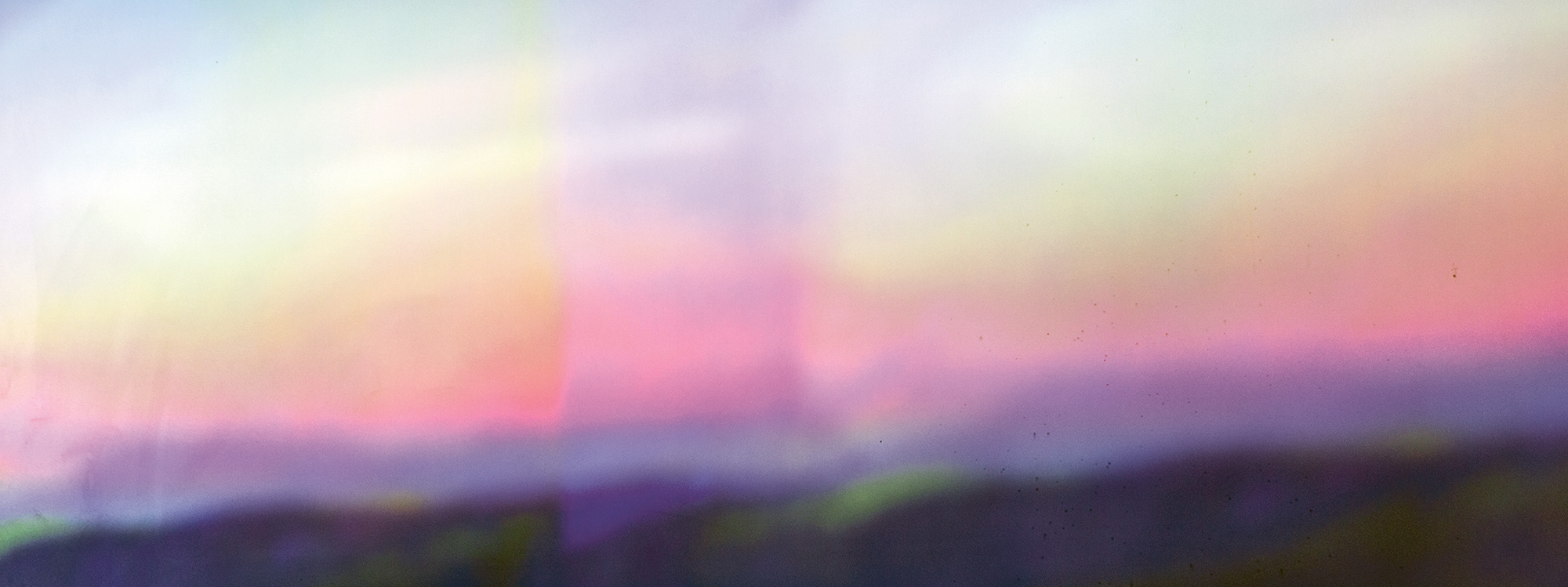
Time Travel (detail), 2019, commissioned by Sharjah Art Foundation- SB14, photo: Caline Aoun

Time Travel (detail), 2019, commissioned by Sharjah Art Foundation- SB14, photo: Caline Aoun

Twilight

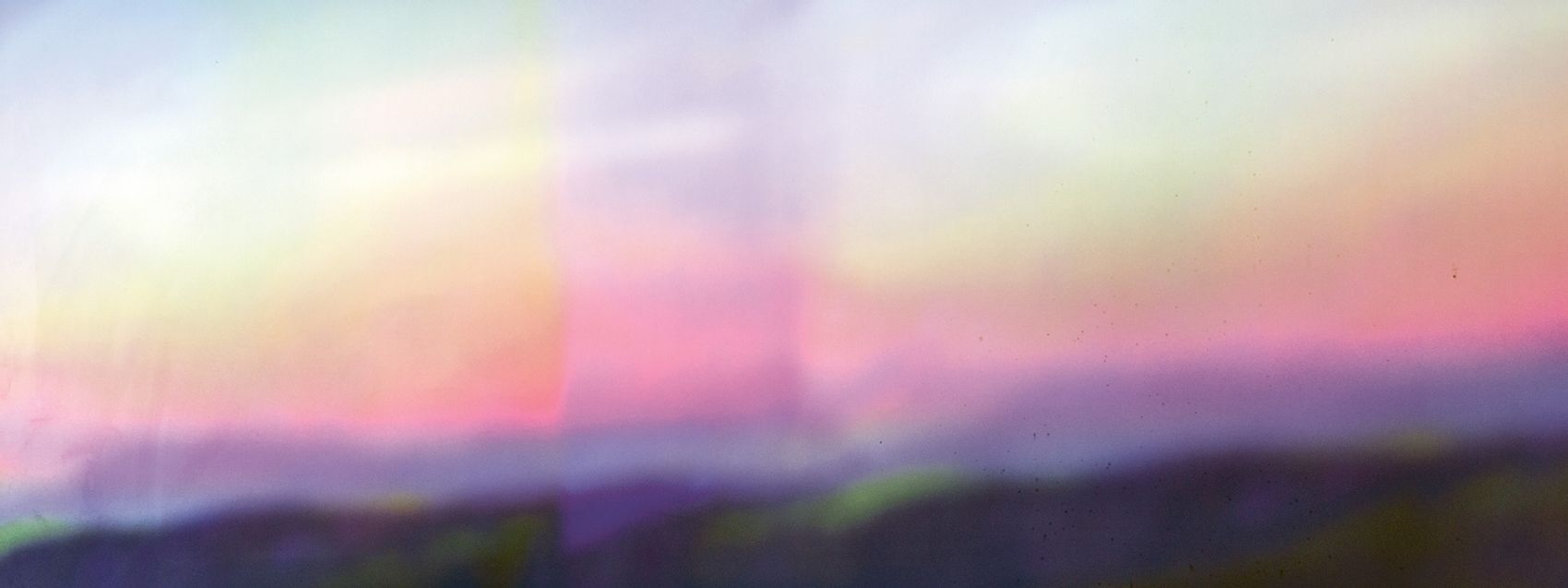
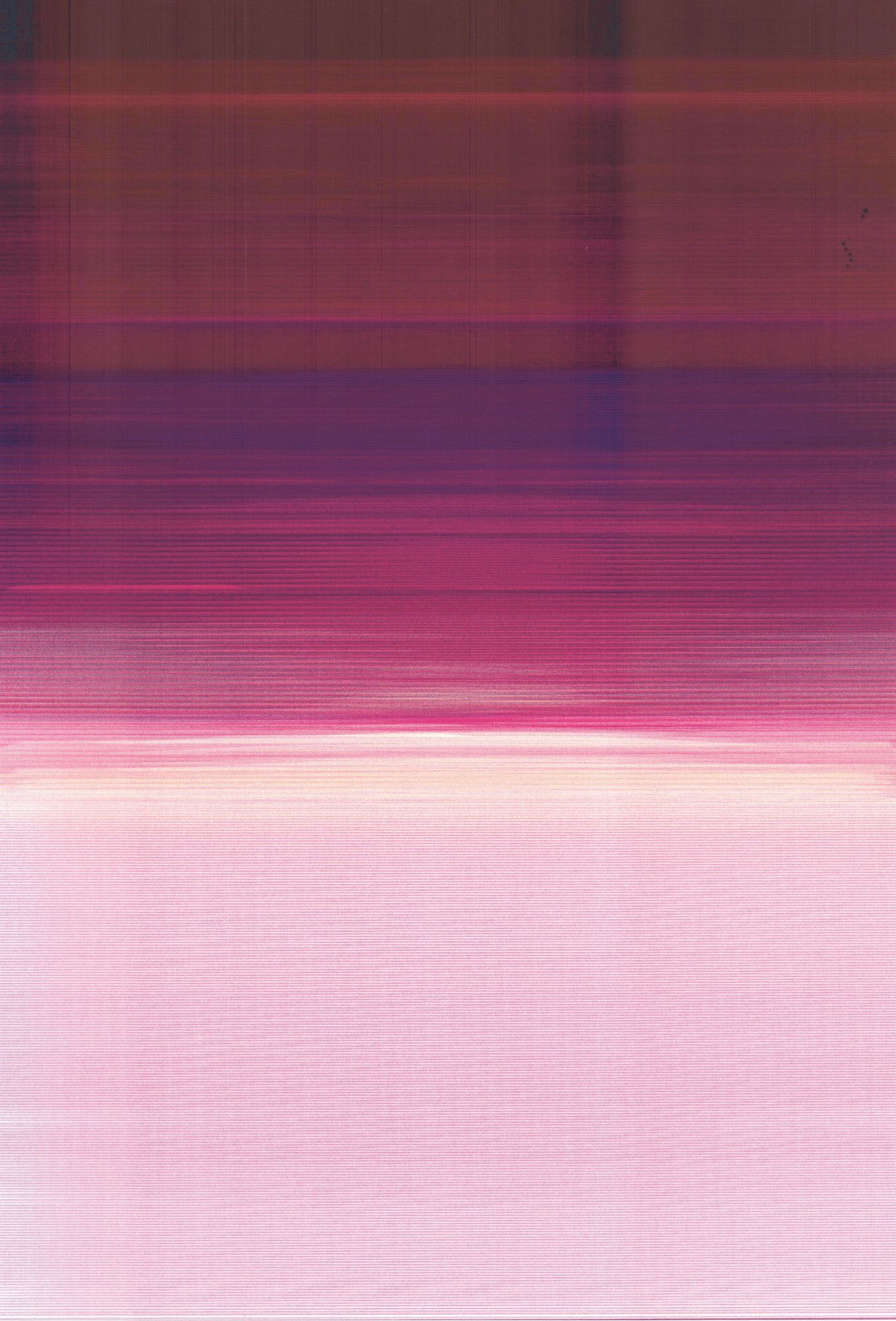
The picture window in the foyer becomes a temporal threshold through projection. During the day, the image is overpowered by daylight and remains latent; only with the onset of darkness does it become visible from outside. The work turns the building itself into a carrier of shifting states. Visibility appears as an inconstant property, contingent upon time of day, light conditions and position.

The projection shows a photograph of a wall onto which a live-streamed sunset was projected using rotating projectors. Spinning at 24 rotations per second, they accelerate the image into a continuous sweep of light. What we see is the trace of this speed, condensing into an unstable image of a sunset.

The title refers to the logic of the moving image and to the speed at which images emerge and disappear. At the same time, the work remains closely tied to the architectural conditions of the site. The window mediates between inside and outside, projection and environment, presence and withdrawal. The work is thus less an image within space than an activation of the building itself.

Sunset at 24 Times per Second connects the elemental focus of the Kunstmuseum with Aoun’s ongoing interest in mediality and time. It shows that an image, too, is a state that appears only under specific conditions. The foyer becomes a transitional space in which perception remains bound to the passage from day to night.

The Threshold of Impermanence
Caline Aoun

Change the build­ing to dis­cov­er the second part of the ex­hib­i­tion:

Kun­sthalle Ap­pen­zell
Ziegeleis­trasse 14, 9050 Ap­pen­zell

Kunsthalle Appenzell Part Two: The Cultural

In the Kunsthalle, the focus shifts from elemental processes to cultural and technological systems. In place of condensation, light and heat as physical forces, circulation, image production, information flow and exhaustion come to the fore. The works examine how images and data become materially operative and what kinds of traces they leave behind. In doing so, a central concern of Caline Aoun’s practice comes into focus: the dissolution of the apparent divide between digital immateriality and the physical world. What in everyday life appears fleeting, invisible or weightless – data, transmission, tech-nical infrastructure – is rendered in her work as a material, time-bound and energy-intensive process.

Printing ink, paper, copper and technical apparatuses form a field in which representation is transformed into materiality. Colours circulate through fountains, prints accumulate into surfaces, devices continuously transmit data and become perceptible as heat. The Kunsthalle thus becomes a site in which digital and image-based processes no longer appear as immaterial phenomena, but as systems with physical duration and energetic consequences. Aoun’s work engages with systems, repetition and process, while combining these with a pronounced sensitivity to material, surface and atmosphere. Her practice touches on questions of post-minimalism as well as contemporary discourses around infrastructure, mediality and ecology.

The parcours follows a trajectory from circulation through accumulation to exhaustion. Images do emerge less as finished results, but as something that gradually transforms through repetition, superimposition and excess. In this, Aoun addresses key conditions of the present: the constant production and circulation of images, the invisibility of the apparatuses that sustain them, and the material costs of these processes. As printing ink condenses into sediment-like layers, or data streams register only as heat at the surface, attention shifts from image content to the conditions of its production. What becomes visible is how information turns into material – and how material, in turn, resists immediate legibility.

It is precisely here that the particular force of these works lies. Aoun is not concerned with representation in a narrow sense, but with the moments at which systems reach their limits: when colours saturate, printers fatigue, surfaces retain heat, or repetition tips into dissolution. Her works do not produce images about our technological present; they set its processes in motion and translate them into physical, spatial and temporal experience. The Kunsthalle thus becomes a resonant space in which the cultural does not stand in opposition to the material, but appears as its continuation under the conditions of digital production.

Room 1

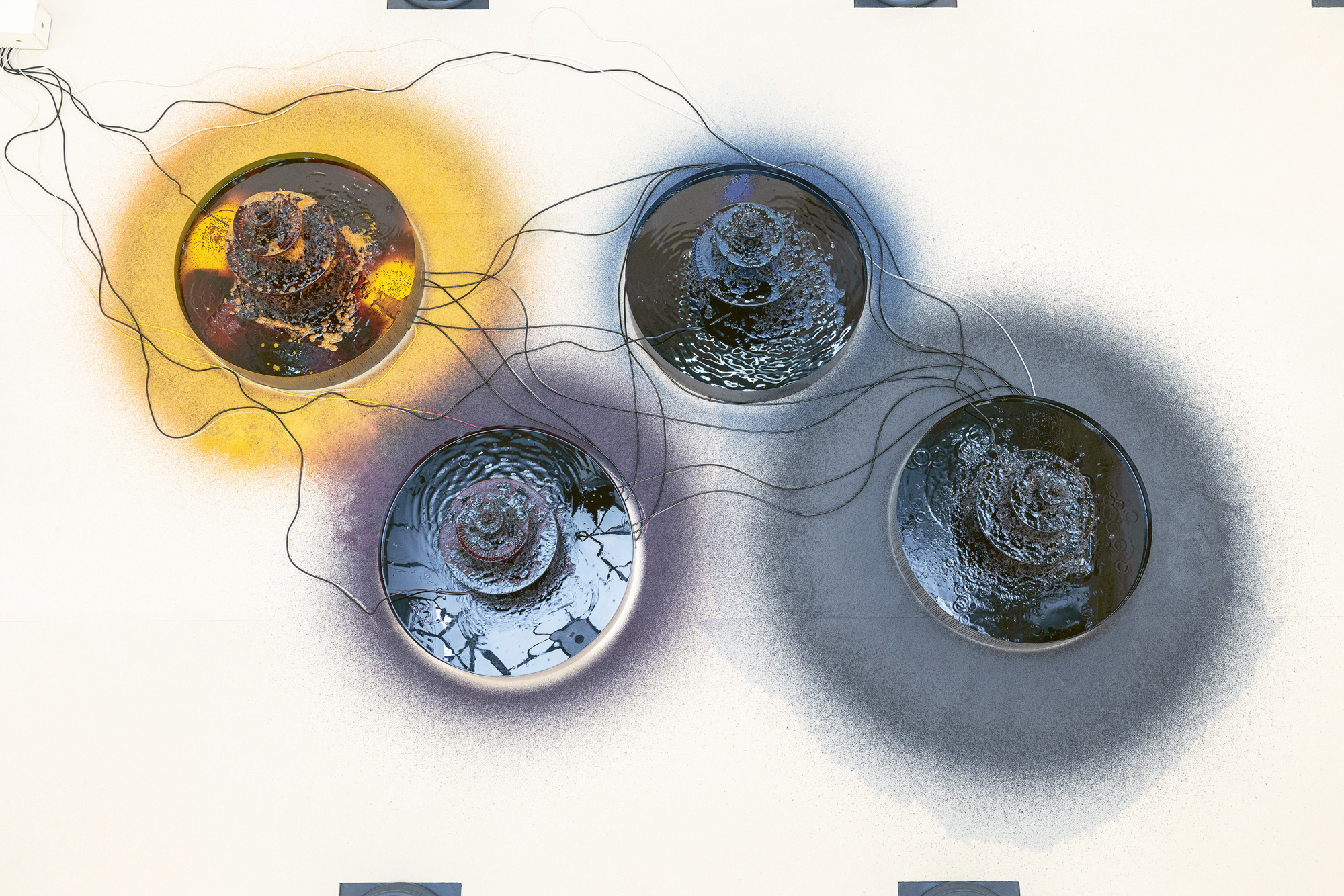
Infinite Energy, Finite Time, 2019, Villa Merkel, Stuttgart, Courtesy the artist and Deutsche Bank, photo: Frank Kleinbach

Infinite Energy, Finite Time, 2019, Villa Merkel, Stuttgart, Courtesy the artist and Deutsche Bank, photo: Frank Kleinbach

Circulation

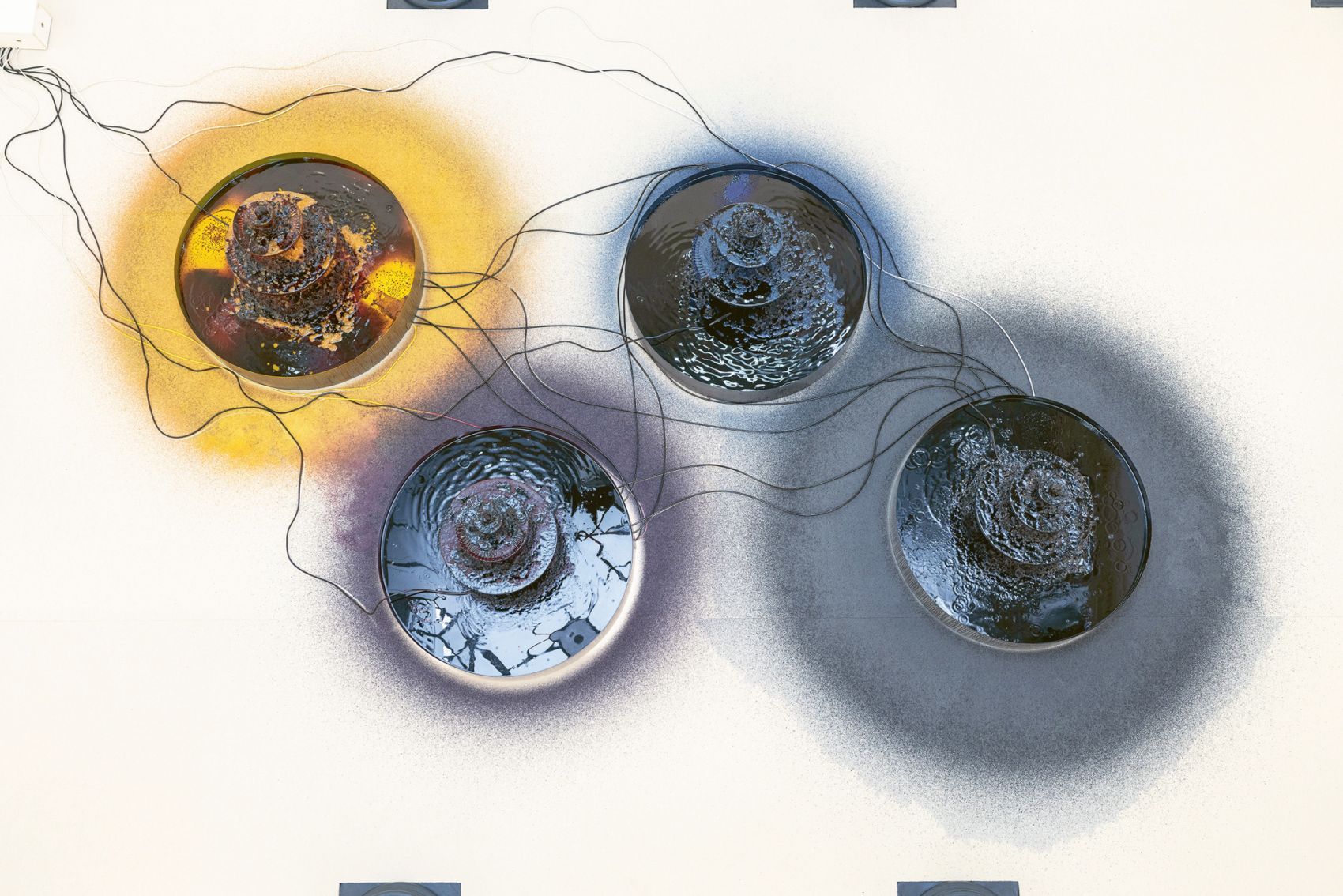
On the ground floor, printing inks in cyan, magenta, yellow and black – the primary colours of the CMYK system – circulate through four fountains. Connected by tubes, valves and pumps, the fountains form a network. Over the duration of the exhibition, the colours gradually mix, becoming increasingly alike until they ultimately merge into black. What in printing is geared towards precision, efficiency and clear legibility is here translated into an open, temporally extended process.

The work replaces the production of an image with a continuous flow. Colour no longer serves to transfer digital data onto paper, but becomes itself a carrier of duration and transformation. The gentle sound of flowing liquid creates a con-templative atmosphere, while a process of accumulation unfolds: circulation does not lead to clarity, but to increasing saturation. What begins as difference dissolves into a homogeneous mass.

In this way, the work renders visible the conditions under which images are produced: transmission, repetition and accumulation. Data does not appear as immaterial information, but as a material process that requires time, consumes energy and inscribes itself as change. Beneath the fountains, carpets register the traces of this system. Splashes and circular marks of printing ink accumulate as sediments of duration, repetition and excess.

Additional carpets, bearing traces created during the installation process, extend the work into the older part of the building (flanking the platform). Infinite Energy, Finite Time thus brings together circulation and exhaustion, image systems and fountain-like display, data flow and material trace.

Room 2

Radiant Data (detail), 2024, Courtesy the artist and Marfa’ Projects, photo: Ros Kavanagh

Radiant Data (detail), 2024, Courtesy the artist and Marfa’ Projects, photo: Ros Kavanagh

Data Stream

The middle floor brings together two forms of accumulation: the energetic duration of digital data streams and the material density of image production. In Radiant Data, technical devices are entirely encased in copper. Beneath the cast surface, iPads continuously stream live data. What becomes perceptible is not the image content, but its consequence: heat. The data remains concealed, yet its presence emerges as a thermal effect at the surface.

Unique inkjet prints, produced through the repeated overprinting of the same surface over several hours, line the walls. A dense, velvety layer of pigment accumulates, within which traces of the printing process – raster patterns, linear markings and slight misalignments – remain visible. Each work is titled with the exact duration of its production, inscribing time as a measurable, material dimension within the image.

The room demonstrates how digital and image-based processes transition into physical states. Data is expe-rienced as heat, printing ink as a sediment of duration and repetition. Representation shifts into material; information into energy.

Room 3

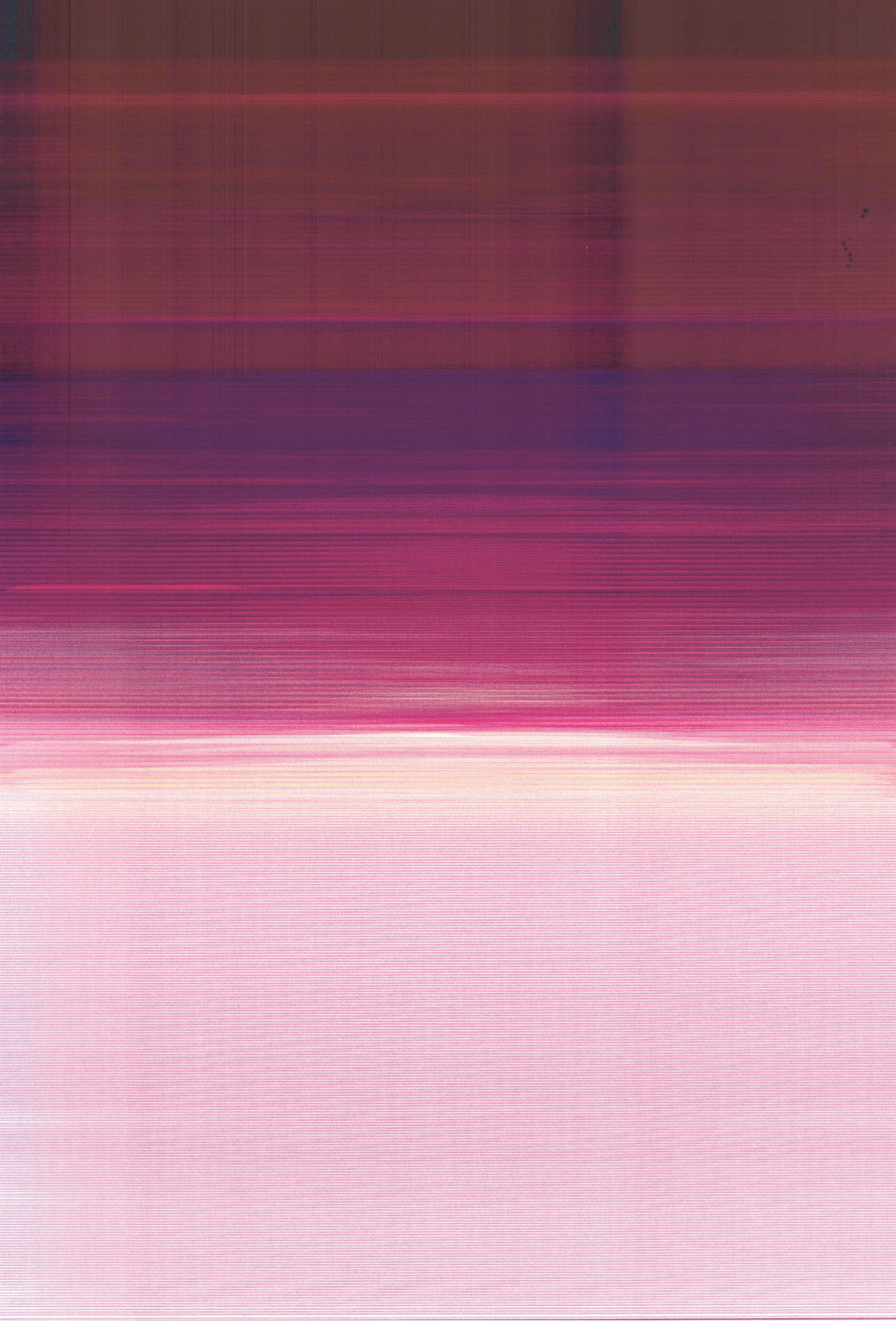
Contemplating Dispersion, 536 ml (detail), 2018, Courtesy the artist and Marfa’ Projects, photo: Caline Aoun

Contemplating Dispersion, 536 ml (detail), 2018, Courtesy the artist and Marfa’ Projects, photo: Caline Aoun

Image Carrier

The upper floor is defined by an installation of coloured works on paper. The sheets are produced through the excessive use of printers pushed to their technical limits. Colour disperses, accumulates and exhausts itself; controlled image production gives way to diffusion, superimposition and dissolution. Together, the works form a field in which an ongoing process solidifies. Grids, shifts and accumulations render the conditions of printing visible, allowing the image to emerge as a temporal deposit.

The title Contemplating Dispersion points to a double movement: on the one hand, order dissolves into dispersion; on the other, the installation slows perception, creating a space of concentration. Images no longer function primarily as carriers of information, but as states of material and duration. Viewers move through a configuration in which image production itself becomes the subject.

The room forms the endpoint of the parcours. The processes addressed earlier – accumulation, circulation, transmission – no longer appear here as a development, but as a condition. Image production continues without arriving at a stable result. Instead of clarity, a field of repetition, sedimentation and difference emerges. In this shift, the logic of the exhibition converges: from the visible to its conditions, from the image to the material trace.

Biography

Caline Aoun (b. 1983, Beirut, Lebanon) lives and works in Beirut. In her artistic practice, she brings together local conditions and global infrastructures and develops works in which materiality, time, technology and perception intersect. Her work spans installation, sculpture, works on paper and site-specific interventions, and explores the physical, ecological and technical conditions under which images, information and objects emerge.

Aoun completed a Bachelor of Fine Art at Central Saint Martins College of Art and Design in London from 2002 to 2005. She then studied at the Royal Academy Schools in London from 2006 to 2009. In 2012, she completed her studies with a Professional Doctorate in Fine Art at the University of East London. Early on, she engaged with printmaking techniques, digital imaging systems and process-based approaches.

Her early solo exhibitions include Scape, Sartorial Project Space, London (2009), and The Future of Smart Technology in Your Hands, Noshowspace, London (2013). Following her return to Beirut, she presented Concrete Layers at Grey Noise, Dubai (2015), and realised Remote/Local as part of Art Basel Statements, Basel (2015). With Fields of Space, Marfa’, Beirut (2016), she established a more spatially expansive, installation-based practice. Caline Aoun gained international attention in 2018 when she was named Deutsche Bank Artist of the Year. In this context, she presented the institutional solo exhibition Seeing Is Believing at MAXXI – Museo nazionale delle arti del XXI secolo, Rome (2018), and later at PalaisPopulaire, Berlin (2020). In 2019, she took part in the Sharjah Biennial 14 with the project Time Travel at the Sharjah Art Foundation, Sharjah (2019). Other major projects include How Will It End?, Villa Empain in collaboration with the Centre Pompidou, Brussels (2021), and Matters of Duration as part of Paris+ by Art Basel, Paris (2022). In 2023, she presented the solo exhibition Are Androids Covered with Electric Dew? at Marfa’, Beirut (2023). In 2024, Caline Aoun realised the large-scale site-specific project The Desert Has No Surface as part of Desert X AlUla, AlUla, Saudi Arabia (2024), as well as the solo exhibition When the Invisible Touches the Surface at The Dock, Leitrim, Ireland (2024). In 2025, this was followed by La Bibliothèque Sensible de Caline Aoun, a permanent installation at the Bibliothèque Orientale of the Université Saint-Joseph, Beirut (2025).

Imprint

KURATORIN / CURATOR

Stefanie Gschwend (Direktorin / Director Kunstmuseum / Kunsthalle Appenzell)

AUSSTELLUNGSUMBAU / EXHIBITION INSTALLATION

Christian Hörler, Christian Meier mit / with Ueli Alder, Flavio Hodel, Dominik Hunn, Tomasz Rogowiec,
Anna Sorokova, Luca Tarelli

ORGANISATION

Stefanie Gschwend, Regina Brülisauer, Luca Tarelli

KUNSTVERMITTLUNG / ART EDUCATION

Domenika Chandra

BESUCHENDENBETREUUNG / MUSEUM ATTENDANTS

Margrit Gmünder, Ian Groll, Nicole Hebeisen, Xiaoping Meier, Barbara Metzger, Heneisha Morris, Yvonne Pola, Madleina Rutishauser, Luca Tarelli, Petra Zinth

HERAUSGEBERIN / EDITOR

Kunstmuseum / Kunsthalle Appenzell

TEXT

Stefanie Gschwend

LEKTORAT / PROOFREADING

Carmen Ebneter, Stefanie Gschwend, Luca Tarelli

ÜBERSETZUNG / TRANSLATION

Stefanie Gschwend

GRAFIK / GRAPHIC DESIGN

Data-Orbit / Michel Egger, St.Gallen

DANK / ACKNOWLEDGEMENTS

Bechara Aoun, Caline Aoun, Carol Aoun, Joumana Asseily, Bachar Attieh, Regina Brülisauer, Marianne Burki, Umer Butt, Myriam Gebert, Christian Hörler, Avedis Kupeyan, Christian Meier, Luca Tarelli, Tisca Tischhauser Stiftung, Domenica Tischhauser, Laetitia Zalloum, Gönner und Gönnerinnen, die nicht
namentlich genannt werden möchten / Supporters who wish to remain anonymous

The Threshold of Impermanence
Caline Aoun
The Kinetics of the Invisible, 2019, Courtesy the artist and Marfa’ Projects, photo: Mathias Schormann

The Kinetics of the Invisible, 2019, Courtesy the artist and Marfa’ Projects, photo: Mathias Schormann

Condensations of the Invisible Space (detail), 2021, courtesy the artist, Marfa’, Beirut and Grey Noise, Dubai, Foto: Musthafa Aboobacker

Condensations of the Invisible Space (detail), 2021, courtesy the artist, Marfa’, Beirut and Grey Noise, Dubai, Foto: Musthafa Aboobacker

Measuring Entropy (detail), 2023, Courtesy the artist and Marfa’ Projects, photo: Ros Kavanagh

Measuring Entropy (detail), 2023, Courtesy the artist and Marfa’ Projects, photo: Ros Kavanagh

After the Water (Or Evaporation Field), 2026, courtesy the artist, commissionned by Kunstmuseum Appenzell, production photo Caline Aoun

After the Water (Or Evaporation Field), 2026, courtesy the artist, commissionned by Kunstmuseum Appenzell, production photo Caline Aoun

Condensations of the Invisible Space, 2023, Courtesy the artist and Marfa’ Projects, photo: Musthafa Aboobacker

Condensations of the Invisible Space, 2023, Courtesy the artist and Marfa’ Projects, photo: Musthafa Aboobacker

The Desert Has No Surface (detail), 2024, courtesy of The Royal Commission for AlUla, photo: Lance Gerber

The Desert Has No Surface (detail), 2024, courtesy of The Royal Commission for AlUla, photo: Lance Gerber

Radiant Alchemy, 2023, Courtesy the artist and Marfa’ Projects, photo: Youssef Itani

Radiant Alchemy, 2023, Courtesy the artist and Marfa’ Projects, photo: Youssef Itani

Pine Needles, 2015, courtesy The Museum of Fine Arts, Houston, museum purchase funded by Chris Urbanczyk, with matching funds from Chevron, and by the Museum Collectors, photo: Caline Aoun

Pine Needles, 2015, courtesy The Museum of Fine Arts, Houston, museum purchase funded by Chris Urbanczyk, with matching funds from Chevron, and by the Museum Collectors, photo: Caline Aoun

Colliding Forces, 2026, courtesy the artist, commissionned by Kunstmuseum Appenzell, production photo: Caline Aoun

Colliding Forces, 2026, courtesy the artist, commissionned by Kunstmuseum Appenzell, production photo: Caline Aoun

Time Travel (detail), 2019, commissioned by Sharjah Art Foundation- SB14, photo: Caline Aoun

Time Travel (detail), 2019, commissioned by Sharjah Art Foundation- SB14, photo: Caline Aoun

Infinite Energy, Finite Time, 2019, Villa Merkel, Stuttgart, Courtesy the artist and Deutsche Bank, photo: Frank Kleinbach

Infinite Energy, Finite Time, 2019, Villa Merkel, Stuttgart, Courtesy the artist and Deutsche Bank, photo: Frank Kleinbach

Radiant Data (detail), 2024, Courtesy the artist and Marfa’ Projects, photo: Ros Kavanagh

Radiant Data (detail), 2024, Courtesy the artist and Marfa’ Projects, photo: Ros Kavanagh

Contemplating Dispersion, 536 ml (detail), 2018, Courtesy the artist and Marfa’ Projects, photo: Caline Aoun

Contemplating Dispersion, 536 ml (detail), 2018, Courtesy the artist and Marfa’ Projects, photo: Caline Aoun

This website uses cookies.

Privacy Policy /