Artists are invited to present films or video works by artists who inspire, move or challenge them, as well as their own work, in the projection room at the Brick Kiln.
The 2026 annual programme explores the theme of 'apparatus', which is understood as systems that shape perception, action and social order. The exhibitions explore apparatuses as interfaces between technology, the body, and community, as instruments of translation, projection, and control. They reveal the processes through which energy, information or meaning are set in motion and transformed into new forms of materiality and experience. Apparatuses appear as both responsive sensors and agents of social dynamics, connecting people, machines, and environments; shaping the rhythms of everyday life; and opening up spaces for reflection on power, dependence, and transformation. In this way, they become models in which the relationship between reality and imagination is constantly readjusted.
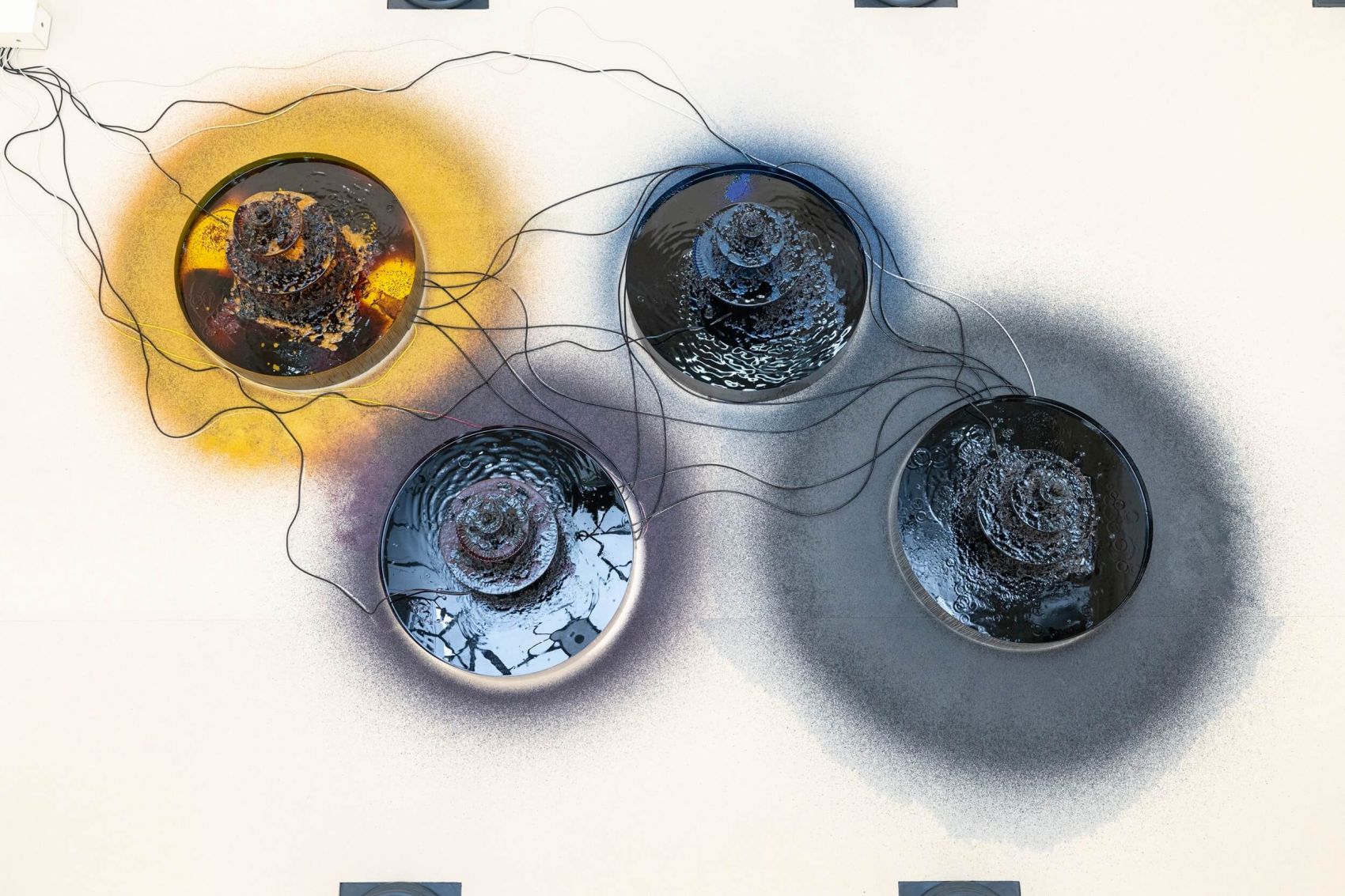
Caline Aoun, Infinite Energy, Finite Time, 2019, Villa Merkel, Stuttgart, Courtesy of the artist and Deutsche Bank, photo: Frank Kleinbach
3 May – 25 October 2026
Kunstmuseum / Kunsthalle
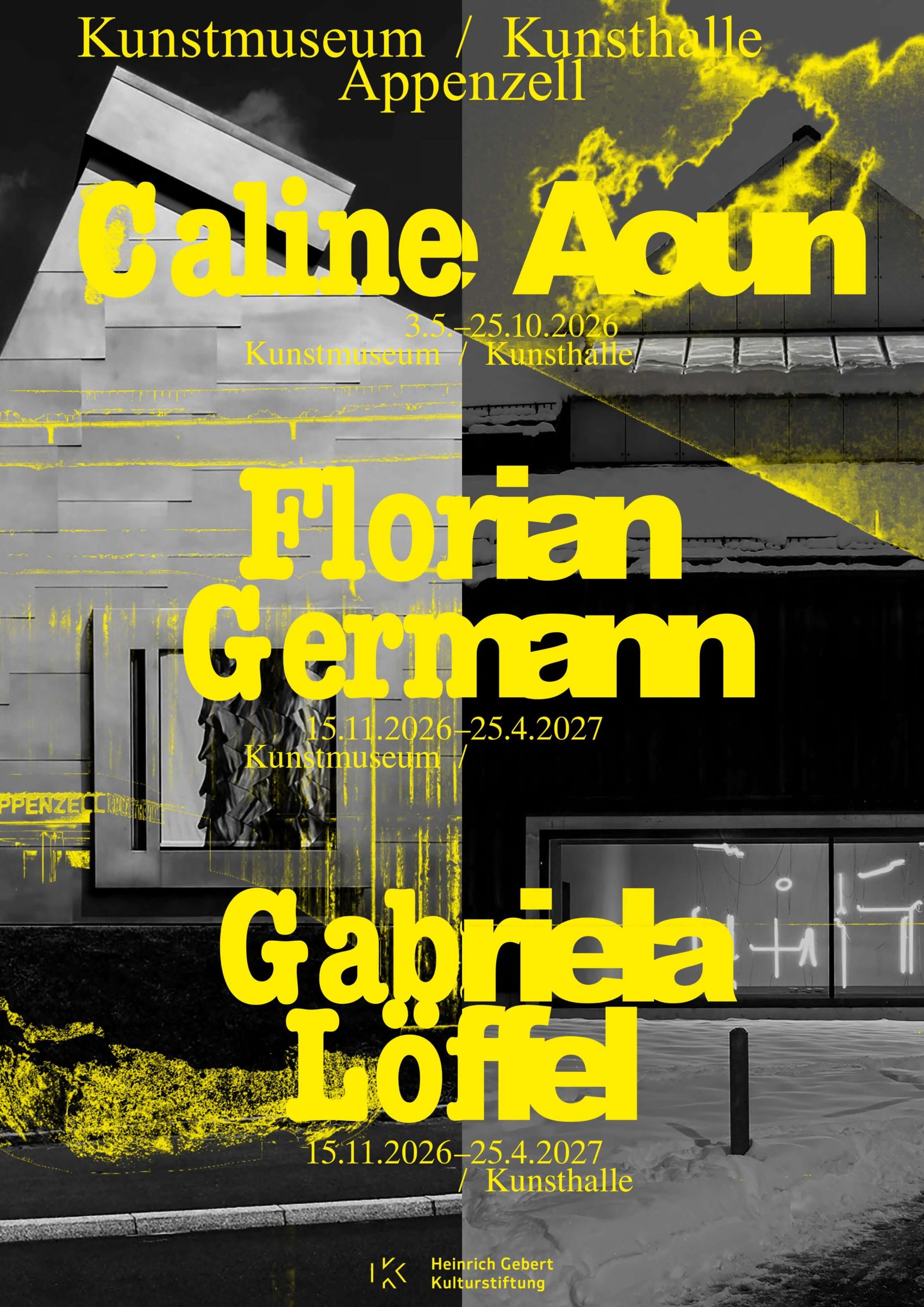
The solo exhibition by Caline Aoun (*1983 in Beirut, Lebanon; lives and works in Beirut) spans the Kunstmuseum and Kunsthalle, presenting artistic approaches in which digital and physical processes interweave. Aoun works with installations and often site-specific media, including sculpture, printmaking, works on paper, and video. Using technical devices and everyday materials such as printing systems, water cycles, or natural substances, she translates phenomena such as light, heat, humidity, or data into aesthetic and sensorial experiences. Repetition, saturation, and delay serve as methods that allow her to explore the relationship between image, surface, and space. The exhibition responds attentively to the architectural and atmospheric conditions of each location, inviting reflection on how constellations of apparatuses and forms structure perception, influence states, and shape reality.

Florian Germann, Untitled 1 (Milano), 2023, courtesy the artist & Galerie Gregor Staiger, Zurich – Milan, photo: Galerie Gregor Staiger
15 November 2026 - 25 April 2027
Kunstmuseum /
In his sculptures and installations, Florian Germann (*1978 in Kreuzlingen, CH; lives and works in Zurich, CH) explores the relationships between humans, animals, and machines. Working with materials that he perceives as carriers of energy, he shapes them into hybrid bodies that appear both familiar and alien. His objects take on the character of organic–technical beings whose surfaces and structures evoke physical as well as mythological forces. Some sculptures develop a life of their own, becoming colonised by insects, birds, or plants and transforming into dynamic systems in which interaction and change play a central role. Germann’s sculptures can become environments that are both perceptual and formative – instruments that channel energy, shape sensory impressions, and forge connections between different forms of life. They evoke apparatuses that receive, transmit, or transform, while leaving open whether they were constructed, grew, or emerged from another reality. This ambiguity creates spaces for speculation in which new ideas of coexistence and materiality can unfold.

Gabriela Löffel, Grammar of calculated ambiguity, 2023-2024, KorSonoR, Genève, photo: Emmanuelle Bayart / Arta Sperto, 2025
15 November 2026 - 25 April 2027
/ Kunsthalle
Gabriela Löffel (born 1972 in the Canton of Bern, CH; lives and works in Geneva, CH) has developed an audiovisual practice that exposes the political economies of our perception. Emerging from years of research in places such as military training areas, security conferences, and the obscure zones of global financial flows, her installations reveal the entanglement of power structures, narratives about systemic relationships, and fictional layers. Löffel employs methods of translation, fragmentation, and distancing to reinterpret voices, reframe images, and deconstruct scenarios. This results in precisely composed spaces in which reality is revealed as a network of narratives, projections, and apparatuses. Central to Löffel's work is the infrastructure of speaking and listening. The artist understands sound as an independent plane in which meanings come into being – often in collaboration with sound artists and musicians. This collaborative dimension is highlighted in the exhibition and expanded to encompass practices of auditory thinking.
ongoing / Kunsthalle

Artists are invited to present films or video works by artists who inspire, move or challenge them, as well as their own work, in the projection room at the Brick Kiln.
ongoing / Kunsthalle

Alongside the principal exhibition programme, the walls flanking the music stage above the brick kiln in the Kunsthalle are being reimagined. In the past, they were displaying works by the painter Carl Walter Liner (1914–1997), in whose honour, and that of his father Carl August Liner, the Kunstmuseum and Kunsthalle (formerly Museum Liner and Ziegelhütte) were founded. Carl Walter Liner can be seen as a pioneer of modern and abstract art in Appenzell, who uncovered artistic possibilities in a rural environment. The wall is constantly changing and is curated in collaboration with local artists. This creates an evolving presentation and a different perspective on the past and present. Christian Meier (born 1978, Appenzell AI) kicked things off with three works, followed by photographs by Ueli Alder (born 1979, Urnäsch AR).
Kunstmuseum / Kunsthalle

The art mediation programme invites all visitors to experience art through mutual exchange, encouraging them to develop their own perspectives. School classes can enjoy interactive tours and practical workshops. Everyone is welcome to use the Kunsthalle's open space, and children and young people can take part in workshops (Goofe Atelier / Atelier für Junge) to express their creative responses to what they have seen. Adults can join guided tours, talks and workshops, and visit the art bar and interdisciplinary day programmes with culinary highlights. Visitors can also explore and study exhibitions in greater depth independently using the provided exhibition materials.
The programme can be found in the agenda on our website. For enquiries, please contact Art Mediation
/ Kunsthalle

On site to browse, explore, discover and linger.
Online at bvsga.ch/kma-khzh
Every first Thursday of the month / 8–11 p.m.
With the museum's director at the counter.
Kunstmuseum /

Since April 2023, the museum’s director has run an art bar held on the first Thursday of every month from 8 p.m. It is located in the basement of the Kunstmuseum, in an oil-tank room that was never put into use, and is known as Heute Tankrevision (Today Tank Revision). The bar remains open for as long as the warning light outside the building continues to flash.
We often hold guided tours or talks on current exhibitions before the bar opens. Please check the agenda for details.
The bar is part of the collection. It is continuously complemented with works of art by regional and contemporary artists who have exhibited at the Kunstmuseum/Kunsthalle.